Keloğlan and Ali Cengiz — An Anatolian Folk Tale
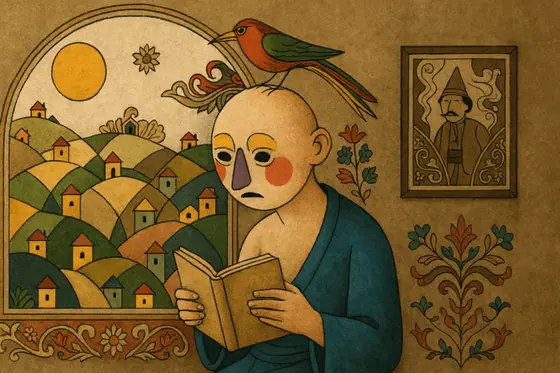
Photo: Luke Besley / Unsplash (Unsplash License)
ℹ️ This is an English translation of a Turkish oral folk tale. The regional dialect of the source text could not be fully preserved in translation. Read the Turkish original Keloğlan ile Ali Cengiz.
Keloğlan and Ali Cengiz is an Anatolian Keloğlan1 tale; it tells the story of a Keloğlan who has no one but his old mother and who works as a shepherd for the villagers' animals.
ℹ️ This is an English translation of a Turkish oral folk tale. The regional dialect of the source text could not be fully preserved in translation. Read the Turkish original here: Keloğlan ile Ali Cengiz.
Once there was, once there wasn't. God's servants were many. Eating much and saying "there is none" was a sin2. Once upon a time, in a remote village of a certain country, there was a Keloğlan. In this narrow world this Keloğlan had no one at all except his aged mother. This Keloğlan worked as a shepherd for the villagers' goods and flocks, and from the early morning until the dark of evening he passed his days in the mountains and on the slopes, tending the animals, roaming and wandering. Between this place and that, mountain and stream, days walked on, months turned, and years strung themselves one onto another. This Keloğlan grew up and came of age. His hands and feet grew big and his height increased. His eyes became ones that made you want to stare and made you want to see them roll about. One day he stood up and said to his mother:
"All my peers and my age-mates in this village have married. They have become the heads of families with wives and children. Mother, marry me off now," and he grinned. His mother said:
"Now then, my boy, Keloğlan, my scab-headed boy3. In this old state of mine I am busy with the house and the garden. I spin wool and knit socks. Whatever I manage to put together, hens or eggs, I sell at the market. And you tend the flock as a shepherd, and we barely get by, bare and plain and just full. With what will you hold the wedding? How will you pay the bride-price? With what will you cook and stir the pot? With what will you feed a bride?" Though she listed the obstacles one by one and pushed the tired uphill, this Keloğlan only grinned and held his ground:
"Now then, Mother, my white-haired and hard-working mother. Do not grieve or fret, do not think about what lies before and behind, and do not worry. Remedies for everything you have listed will be found. Shortages will be filled. Obstacles and difficulties will be overcome even if they are as big as mountains. You just get ready to go and ask for a bride," he said. At first the poor woman resisted and said no, but in the end she thought once and scratched her head twice. She reckoned that if a bride came to the house she would be a helping hand and a companion for her, and a help in her work, and she turned and asked her son:
"Now then, my boy, Keloğlan, my scab-headed boy, my boy with the smiling face. Let us say we have found a way. We have seen to the preparations. Whose daughter shall we ask for, and at whose door shall we knock?"
Keloğlan kept grinning, waiting for his mother to come round. Hearing this, he said at once:
"Oh, Mother, what is there to think about or consult over? Of course the most exquisite and most beautiful girl in these parts. You will go and ask for the padishah's daughter," and he puffed himself up. His mother, who understood where her son's bird-like heart was flying about, was struck dumb. She paused for a while and then turned to her son:
"Now then, my son, my bald son, my scab-headed son, my son with the smiling face, have you lost your wits, have you stirred up dust? He is the padishah of this land. He is mighty and magnificent, with more business than he can handle, and his wrath overflows his gate. With wind at his neck and a frog's belly4, he sits down with cries of 'hail' and gets up with cries of 'woe.' Whoever sees him fears him; he is a shah with executioners and a taste for the executioner's work. Would he give you his daughter? They would drive me away from the palace gate. Don't do it, my child, don't go on so; let us find you a poor motherless and fatherless girl, an orphan on both sides," she said, but Keloğlan held out, saying, "No." His bald head turned red and his gray-blue eyes bulged.
"Now then, Mother, my white-haired and hard-working mother. What I have said, I have said, and the whistle I blow is the one that counts. Do not fret or be sad. You will go to the padishah's gate. You will sit on the petitioners' stone5. They will bring you before the padishah, and you will insist and ask for his daughter. What fault do I have, what defect? I am a strapping young man. If this padishah does not give his daughter to me, to whom will he give her? Come, Mother dear, be quick. Go to the palace early tomorrow morning and sit on the petitioners' stone. When you are brought before the padishah, tell him one by one that I ask for his daughter. Do not be afraid or hold back. We will take this girl," Keloğlan insisted. The next morning the poor woman smartened up her clothes a little, put on a piece or two from her chest, and came to the palace gate. She left the beggars' stone beside the gate and sat on the petitioners' stone. The doorkeepers, the bostancis, and the baltacis6 saw her and asked what she wanted and what she wished for. When she said that she wanted to see the padishah and that she had a request, they sent word to the padishah. The padishah was curious about this poor woman who wanted to see him and was sitting on the petitioners' stone, and he ordered that she be brought to him. The bostancis and baltacis took Keloğlan's mother by the arm and led her through doors, took her around gardens, made her cross courtyards, walked her through halls and corridors, brought her up staircases to the front of the padishah's chamber, and left her there.
The poor woman trembled with fear, her heart would not fit in her chest, and her hands and feet tensed and loosened by turns. If she opened the curtain and went in, it was one kind of trouble; if she did not, it was another. Aside from being driven away and chased off by the padishah, she feared above all that he would rage at Keloğlan and hand him to the executioner. But there was no use in standing at the door worrying to herself. She shut her eyes and lifted the door curtain and went in. At once she bowed to the ground in greeting and walked to the front of the padishah's throne. The padishah looked at the poor woman and said:
"Come, good mother7, do not hold back and do not be flustered. Tell me whatever you wish."
The poor woman was frightened by the padishah's anger and awe, and she bowed her neck, folded her hands, and stood rooted to the spot. Her tongue would not loosen and she could not speak. The padishah waited and waited, and then said:
"Come closer, lady mother, do not be afraid or startled; whatever your purpose and aim, tell it!" At that, Keloğlan's mother came closer and gathered herself:
"My fortunate, majestic, lofty, and glorious padishah. I have a little son. In these parts his name has gone out; he has become famous as Keloğlan..."
"Now tell me, say it, what has happened to this Keloğlan, what do you want, what do you wish?" he said, and the poor woman said:
"I will say what I want and wish, but I hesitate for fear that you will be angry and rage," and the padishah took pity on her and, considering her years, said:
"No, no, I will not be angry, and no harm will come to you. I have given you leave, say whatever you wish, however you wish, mother!" he said to her. When the poor woman heard that the padishah took pity on her and had given her leave, she felt relieved, drew breath, and began to speak:
"My son herds the villagers' flocks and goods over mountain and slope, grazes them, and works as a shepherd, and I look after the garden, sell hens and eggs, spin wool, and knit socks. Hand in hand and head to head, we put together whatever we find, oily or plain, and get by. Last evening he stood in front of me. 'My peers and my age-mates have all married and become heads of families with wives and children. Mother, marry me off,' he kept saying. I said, 'Let us look for a suitable girl,' but he insisted that it must be the padishah's daughter, saying, 'What fault do I have, what lack?' and he held out. Have mercy, my padishah, what can I do, he is my child; his heart is in the heights and his mind in the air..." At that the padishah burst into laughter and laughed and laughed for a while. Then he said:
"What is there to be angry about in this? He is a youth, is he not? Of course his heart is in the heights. A girl is asked for by forty men, and she falls to the lot of one. I will give my daughter to this Keloğlan of yours, but on one condition: he must go and learn the game of Ali Cengiz8, and only when he comes back may he take my daughter..."
The poor woman was astonished and glad at the padishah's answer. She withdrew backwards, bowing seven times. All the while she praised the padishah and prayed for him. In a flurry, all sails and oars, her hands and feet tangled, stopping now and then to calm her heart, she reached home and brought the good news to Keloğlan:
"Now then, my boy, Keloğlan, my scab-headed boy. Your affair has worked out, and the sun has risen for you. The padishah has agreed to give his daughter, but he has set a condition. You are to go and find Ali Cengiz and learn his game, whatever it may be, completely. On this condition he says he will give his daughter to my son. Now hurry up; one whose heart is high must have quick hands, and his skills must be of the highest!" At this Keloğlan grinned and said:
"Oh, Mother, my white-haired, hard-working mother. Do not grieve or fret, do not think about what lies before and behind, and do not worry. What is easier than that? I will get ready now and set out. I will search for Ali Cengiz and find him. Whatever his games and arrangements are, I will learn them completely and return," and he and his mother set out together and walked on.
In that land there was a master player named Ali Cengiz, whose fame had been heard and whose name had spread, and he knew games, skills, and arrangements. Young men flocked to him from the seven climes and the four corners, stayed with him for forty days, and he taught them everything he knew. On the fortieth day he would ask them:
"Now then, boys, have you learned the games, the arrangements, and the skills from beginning to end?" and if they said, "We have learned and memorized them, master," he would at once take them down into the cave beneath his house, cut and chop them up, and throw them into a blind well. He did not want any of them to find the way and take his place.
Keloğlan and his mother walked a little, they walked a great deal, over hill and dale, straight on. Covered in the dust of the roads, turning around the crags9, crossing streams, hopping along bit by bit, they walked on. They grew tired and sat down under a tree and leaned back, and as they opened their provisions bag and ate bread and cheese, a man burst out from the opposite direction and came. He planted himself in front of Keloğlan:
"Where do you come from, Keloğlan, and what do you seek in these parts?" he asked him. Keloğlan answered:
"I have set out to look for the master Ali Cengiz. I must learn his games, his arrangements, and his skills completely, in due order and form. I am asking about and following, as you see," he said. As it turned out, the man standing in front of Keloğlan was Ali Cengiz himself.
"I am the master they call Ali Cengiz. You will come to my house and be bound to me, and for forty days you will look after my work and service. Every day I will teach you one game, arrangement, and skill. On the fortieth day there will be an examination, and you will return to your village," he said. At this Keloğlan gathered up his bag and his provisions, got up, and kissed his master's hand. He parted from his mother and followed his master. Ali Cengiz took him and brought him to his house.
In Ali Cengiz's house there were his wife and his daughter. His master brought Keloğlan, shut him up in an empty room, and went out into the street. After Ali Cengiz had gone, the mother and daughter took pity on Keloğlan and came up to his door. The girl called to him through the keyhole:
"Oh, Keloğlan, poor scab-headed boy. My father will teach you all his games, arrangements, and skills within forty days. On the evening of the fortieth day he will examine you and question you. You must act as though you have learned none of the games, arrangements, or skills. You must give the conditions, the way, and the method of each one wrongly. If you say, 'I have learned, master,' and go about the matter correctly, that is the day your head will be cut off and you will be thrown into the well. So you will save your neck and escape from his hand," and she taught him point by point. Keloğlan sat and waited for Ali Cengiz. Not long afterwards he came. From the very first day he began to teach Keloğlan his games, arrangements, and skills, starting from the smallest and going on to the greatest. Keloğlan learned everything he was taught, completely, and he grasped the acrobatics and conjuring of the business, and went beyond them, and even reached mastery. On the evening of the fortieth day, Ali Cengiz put him to the question and the examination.
Whichever game he asked about, Keloğlan told it incompletely, got things wrong, and mixed them up with each other.
"My son Keloğlan, scab-headed boy, boy with gray-blue eyes and a copper face, have you learned this game, have you learned that game?" each time he asked, Keloğlan grinned, and went on grinning, and said:
"Oh, master, mighty master, my mind is confused and my wits are tangled. I can't tell one from the other and don't know them. Please tell me once more," and each time Ali Cengiz felt his heart ease and his spirit open:
"Now then, you fool, you aimless, useless boy. Alas for my labors, alas for my days gone to waste!..." he said, and, delighted, with his heart leaping for joy, he gave him leave that very evening and sent him off safely. Keloğlan put his bag on his back and took his stick, and together with his mother, who had come to fetch her son, they took the road to their home.
As they went on and on, hopping bit by bit, turning around the crags, crossing streams, their road came upon a forest. In the forest Keloğlan saw hunters going about after hares. He said to his mother:
"Mother, now I will play a trick and become a greyhound. I will dash here and there and catch hares and show my skill. The hunters will want to buy me from you. Bargain and sell me for five gold pieces. But whatever you do, do not give up the collar around my neck. Oh, Mother, if you give up the collar, consider me dead!"
When Keloğlan had finished speaking, he said "hop" and became a greyhound. He went after a hare that was leaping and bounding out from the bushes, caught it, took it by the back in his mouth, came out in front of the hunters, and held it up and presented it. All the hunters liked this greyhound, which ran as if flying, which sprang on game like a falcon, and which brought back whatever it chased as if snatching it up, and they praised it. They came before the woman and became buyers. They haggled and agreed on five gold pieces. The woman took off the collar and handed the greyhound over to them. They put another collar on its neck. They again began to roam about after hares, saying, "here and there." When another hare burst out of the bushes, they let the greyhound loose. It leapt and bounded after the hare that ran uphill, bore toward the mountain, and vanished from sight. It stopped in a suitable place and took the form of an old woodcutter with an axe in his hand, and began to chop wood, tak, tak.
The hunters, searching here and there, followed the greyhound up the mountain. They saw that an old woodcutter was chopping wood there, tak, tak. They came and asked him:
"May you meet with good fortune, abundant and auspicious, father woodcutter. Did a greyhound running after a hare pass by here? Have you seen it?"
Keloğlan said:
"It just passed. It crossed that hill a moment ago. It was going like the wind, with a whirr," and the hunters ran off in that direction. Keloğlan, in the guise of the old woodcutter, came down from the mountain and found his mother, and they turned and set out on the road at once, and walked on.
They reached their home. A while passed. Ali Cengiz had heard what had happened only in bits and pieces, from this person and that, but he understood the truth of the matter. He grasped clearly that Keloğlan had tricked him10 and saved his head, and that although he had learned all the games, he had made himself look foolish and saved his neck. "Two sheikhs do not sit on one sheepskin. There cannot be two Ali Cengizes in one land," he said, and set out on the road and went after Keloğlan.
While Ali Cengiz went about searching and inquiring here and there, let us come to Keloğlan and his mother. One morning he said to his mother:
"Now then, Mother, we have used up the greyhound's money. There is no money left in hand. Let us see to our affairs and keep up our trade. Now I will take the form of a ram. You tie this rope to my horns and take me to the market. Stand firm and bargain well; you will not sell me for a para less than sixteen. When the bargaining is finished, untie this rope from my horns and take it. If you do not untie and take this rope, you will never see me again," he said, and he shook himself, whirr, and became a huge ram with curling horns. His mother tied the rope Keloğlan had given her to the ram's horns. She pulled him and took him to the market. Many buyers gathered around the woman to buy this fat, handsomely horned ram. Ali Cengiz came to the market at that time, looking neither this way nor that. He recognized the woman at once. He knew she was Keloğlan's mother. He came up to her, parted the crowd, and became a buyer.
"For how many liras are you selling this ram, lady mother?" he asked, gently and politely. The woman did not recognize this Ali Cengiz:
"I won't let it go for a penny less than sixteen. Such a splendid ram has never been seen at the market," she said, and Ali Cengiz at once seized the woman's hand and shook it in the villagers' way, raising the price of the ram and pushing aside the other buyers.
"I will give you twenty gold pieces. I like this ram. I will make him the leader of my flock. But I want him together with the rope on his head, mind you!..." he said. When the woman heard twenty gold pieces, she nearly lost her mind. She forgot her son's warning, and the glitter of the bright gold pieces dazzled her eyes. When she had counted the twenty gold pieces into her palm and was about to hand the ram's rope to Ali Cengiz, the ram shook himself, whirr, and became a sparrow and began to fly. Seeing this, Ali Cengiz at once became an eagle. He rushed after the sparrow and attacked. The sparrow flew, the eagle flew. The sparrow went, the eagle went. Just as he caught up and was about to seize the sparrow, the Keloğlan in front of him at once became a bunch of roses, darted in through the window of the palace, and fell into the lap of the padishah's daughter.
The Lady Sultan11 was delighted with this bunch of roses that had come flying from the sky and fallen into her lap. She smelled it to her heart's content, pressed it to her breast, and ran to her father. Ali Cengiz, who watched this from a branch of a tree in front of the window, at once took the form of a beggar and came down to the ground. He went straight to the palace and appeared before the padishah:
"My padishah, fortunate, glorious, and just padishah, a bird of prey snatched the bunch of roses in my hand. It dropped it in through the Lady Sultan's window. Please let them give me back my roses, my padishah; command that this poor man be given back his bunch of roses," he said, weeping and wailing, pleading and burning with grief. Just then the Lady Sultan came and was showing her father the bunch of roses in her lap. When she heard the beggar's words, she said at once to her father:
"Oh, Father, my mighty father, my just padishah, this bunch of roses is my fortune. I will give it to no one; it is my right," and the padishah looked at his daughter and then at the beggar's wretched, destitute state, and, helpless, said:
"Oh, my delicate daughter, my beloved child, now that its owner has come and is asking for it, it is not possible not to give it. And it does not fit my justice," he said. Although the princess did not want to give up the roses, when her father's patience ran out and he knit his brows, she was forced to hold out the bunch of roses to the ragged beggar, and before his hand had even touched the bunch, the bunch of roses turned into millet and scattered over the floor. Seeing this, Ali Cengiz in the guise of the beggar at once turned into a mother hen with chicks behind her, clucking, "git git git," and began to peck at the millet on the floor, scurrying about fast. Keloğlan, who had turned into millet and scattered over the floor, saw that things were going badly. He gathered himself at once. He turned into a yellowish-red, sly fox, and gathered up the mother hen and swallowed her whole. He sat in a dog's squat and began to lick himself and stroke his whiskers.
The padishah and his daughter stood in a corner, amazed at all that had happened, with their eyes wide, unable to understand what was going on. "Could jinn have overrun the place? Or are we dreaming?" they said, looking at each other, and as they watched the fox sitting and licking himself, the fox whirled about, whirr, and suddenly appeared in the guise of a handsome young man. Father and daughter looked at this young man and felt a little relieved. They liked the young man very much, too. Keloğlan turned to them and said:
"Here I am, my padishah, my just shah, the one they call Keloğlan. I sent my mother as an envoy; I had wished to marry the Lady Sultan. You had made it a condition that I learn the game of Ali Cengiz. In your presence I have beaten Ali Cengiz, I have shown my game, and moreover I have reached the rank of master. Now there is no one in this world but me who knows these games, arrangements, and skills. I have kept my word, and now I am waiting for you, my padishah," he said, and he bowed his neck, modest and well-mannered, and waited.
The padishah paused once, thought twice. He put it into the full and it would not take, he put it into the empty and it would not fill. Leaving aside that to go back on his word would give him a bad name among the people, he also took into account this Keloğlan's Ali Cengiz games. If he himself did not agree, he would have to contend with this young man and compete with him, and defeat him and remove him without stirring up trouble. In his old age he could not bring himself to face such a hard and dangerous affair. It seemed more fitting, as a show of his justice, to hold a wedding feast, and to take this Keloğlan to his side and employ him in the service of the state.
"Oh, my son, my mighty son, I have made you my son-in-law, I give you my daughter. And I make you vizier as well. Let messengers go out to the four quarters, let guests come. Let the drum and zurna be struck, let the wedding feast be held," he said, giving orders and issuing decrees. Keloğlan came forward and kissed the hem of the padishah's robe. From that day on, a wedding was held for forty days and forty nights; they ate, drank, and made merry. They married Keloğlan to the Lady Sultan. They reached their heart's desire; now let us climb onto our own couch12.
Translator’s Notes
1. Keloğlan ("Bald Boy") is the stock hero of a large body of Turkish folk tales: a poor, bald (or scabby-headed) young man who lives with his mother and wins through cleverness. The name is kept in its Turkish form throughout. ↩
2. "Bir varmış, bir yokmuş" ("once there was, once there wasn't") is the standard opening formula of Turkish folk tales, roughly equivalent to "once upon a time." "Tanrının kulu çokmuş. Çok yemesi, yok demesi günahmış" is a customary continuation of this formula, meaning roughly that there were many of God's servants and that to eat much and then say "there is none" was a sin. ↩
3. "keleş oğlan" is a rhyming epithet attached to Keloğlan. "Keleş" can mean "scabby, mangy" or, in some usages, "handsome"; the sense here could not be verified, and "scab-headed" is the most probable rendering given the pairing with "kel" (bald). [verification needed] ↩
4. "Ensesi yelli, kurbağa belli" is an idiomatic description of the padishah, here rendered literally ("wind at his neck, frog-bellied"). Its exact sense is uncertain; it seems to describe a puffed-up, arrogant man. [verification needed] ↩
5. The "dilek taşı" is a stone near the palace gate on which petitioners sat to make their wish known to the ruler. ↩
6. "Bostanci" and "baltaci" were members of palace service corps in the Ottoman tradition (palace gardeners who also served as guards, and axe-bearing guards). The Turkish terms are kept. ↩
7. "Valide" is literally "mother" and is used here as a respectful form of address to an elderly woman. ↩
8. Ali Cengiz is a legendary master of tricks and cunning in Turkish popular tradition; "Ali Cengiz oyunu" ("the game of Ali Cengiz") is also a Turkish expression for a cunning trick or ruse. In this tale he is a master who teaches such games for forty days. ↩
9. The Turkish "keselerden dönerek" is unclear. "Kese" may be a dialect word for a rough or barren stretch of ground, but this could not be verified, so "turning around the crags" is a tentative rendering. [verification needed] ↩
10. The source reads "dekten attığını"; "dek" is probably a dialect word for a trick or deceit (so "tricked him"), but this could not be verified. [verification needed] ↩
11. "Sultan hanım" ("Lady Sultan") is used here as a title for the padishah's daughter; elsewhere she is called "the padishah's daughter" or "the princess." ↩
12. "Onlar ermiş muratlarına, biz çıkalım kerevetine" is a traditional closing formula, roughly "they reached their desire; now let us climb onto our own couch (kerevet)." ↩
Source
Tahir Alangu, Keloğlan Masalları, as credited at the end of the Turkish text. The Turkish file does not state whether he collected or retold the tale.


