The Monkeys' Buddha — A Japanese Folk Tale
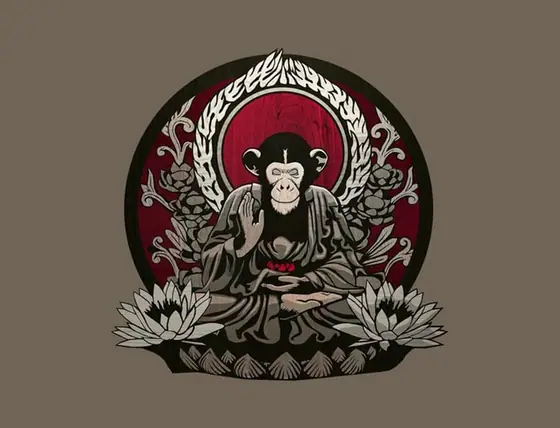
Photo: Bob Brewer / Unsplash (Unsplash License)
ℹ️ This is an English translation of a Turkish oral folk tale. The regional dialect of the source text could not be fully preserved in translation. Read the Turkish original Maymunların Budası (Japon Masalı).
The Monkeys' Buddha is a Japanese folk tale; it tells the story of an old couple whose crops in their little field are snatched away by insatiable birds.
ℹ️ This is an English translation of a Turkish oral folk tale. The regional dialect of the source text could not be fully preserved in translation. Read the Turkish original here: Maymunların Budası (Japon Masalı).
### The Monkeys' Buddha (Japanese Folk Tale)
Once there was an old man and an old woman. If it had not been for the birds, they could have lived contented with their lives. However lovingly the old man worked in his little field, and however carefully he cleared out all the weeds, the insatiable birds came and ate all the sprouts. The old man never got the harvest he hoped for. Even at night he kept tossing and turning in his bed. In his dream he saw giant birds swarming over his field and eating all the crops down to the last grain. In the morning he would wake up drenched in sweat and exhausted.
"We cannot go on like this. Prepare me something to eat. You must have some colorful rags, find a few. I will dress up like a scarecrow. Let us see whether I can scare the birds!" said the old man after yet another sleepless night.
The old woman cooked millet dumplings. To find rags, she rummaged through the corners and edges of their chests. The old man dressed up. He made such a fine scarecrow, you should have seen it! A green cap with a great many pompoms, a jacket and a tunic made of pieces of white, black and blue cloth with huge flowers, and a red scarf for a belt. In this ridiculous outfit the old man stood in the middle of his field and, waving his arms, made the rags truly waltz. He kept hopping from one foot to the other. Indeed, not a single bird dared to fly over the field or to eat the tiniest grain.
"I will show you who I am. You dirty gluttons! From now on you will not be able to gobble up my seeds."
The old man was very pleased with his invention.
The sun was rising slowly in the sky. The old man was waving his arms more and more loosely. He was swaying more and more heavily from one foot to the other.
"I have chased the birds for a good while. I can sit down for a little now to gather my strength," he said at last.
He sat down cross-legged, took a dumpling from his bundle, ate it, and his arms dropped to his knees and his head to his chest. He began to sleep deeply.
It was a hot summer day, the sun was shining brightly, and there was not a sound around. The birds had taken refuge in the shade. The old man slept deeply.
Suddenly a troop of monkeys burst out of the forest, shrieking. At first they looked around curiously. One of the monkeys was making more racket than the others. He noticed the old man standing at the edge of his field in colorful rags and called his friends. They surrounded the strange old man. They kept coming closer. If that colorful thing had moved even a little, they would have run away. But the old man was fast asleep and unaware of what was happening. As he stood there without moving, the monkeys grew bold. One of them grabbed his bundle and pulled out the dumplings. They gulped the dumplings down in an instant. Then an elderly monkey came right up to the old man, and after studying him carefully, said to the others:
"Do you know what this is?" he said. "This must be a new statue of the Buddha, and the dumplings must have been brought as an offering."
"You are right, it must be a new statue of the Buddha. How beautiful it is, I have never seen a Buddha like this," said another monkey, gently touching the colorful rags with admiration.
The monkeys had no fear left. They shrieked, they shouted in an uproar, and they kept tugging at the rags and pompoms.
Finally the eldest of them made a suggestion: "Let us take this Buddha to our temple. When the other animals see that we have such an extraordinary Buddha, they will envy us."
The monkeys loved the suggestion. Some of them joined hands to form a litter, and the others carefully placed the Buddha upon it. Well, in the end the old man woke up at the noise. He had heard everything the monkeys had said about him. He grew very curious. He wanted to know where the monkeys would take him. "I will stay still as if I were made of wood," he said to himself. "I will not let on anything to them. When I tell this crazy adventure, how astonished the old woman will be!"
The monkeys carrying the Buddha walked carefully. When they reached the bank of the river, they searched for a while for a ford1. They did not want their magnificent Buddha to get wet. At last they found a ford and gently stepped into the water. Because they had such a beautiful Buddha, they began to sing. Each monkey sang the song after his own fashion. But they really liked the song.
"Mind your steps, careful, let the Buddha not get wet. Hey, hey, mind your steps."
One of the monkeys broke off his song and shouted: "Hold the Buddha high up. It does not matter if your tails get wet, so long as the Buddha's tail does not get wet."
And all the while he held his own tail up in the air so that it would not get wet.
The old man could hardly keep himself from bursting into laughter. It was very strange to see the monkeys fussing so much for his comfort!
At last they crossed the river and came up onto the bank, raising a great commotion, and carried the old man to their temple at the very top of the mountain. To tell the truth, it was not a temple but rather a deep cave. As an altar there was an old piece of wood, which the monkeys had no doubt taken from a ruined temple.
The monkeys set down their magnificent Buddha. They looked at him from close up and then stood at the mouth of the cave, shouting: "Here is the most magnificent of Buddhas! There is not another like him in the world!"
At last they thought that they must make offerings so that the Buddha would be pleased with the place. At once each of them scattered in a different direction to find a gift worthy of the Buddha. Several hours passed; the monkeys returned to the cave one by one. Each left whatever he had found on the piece of wood. As they made their offerings they prostrated themselves and sang in trembling voices: "O great Buddha, accept the gift of this poor monkey."
One left a handful of walnuts, another a root full of sap. A monkey even brought a gold coin that he had no doubt snatched from a merchant or an absent-minded pilgrim. Some brought a broken fan or pieces of colored glass; in short, each brought the Buddha the most valuable thing he possessed. The line of monkeys seemed endless, and the offerings on the altar began to pile up. From standing so still, the poor old man ached all over. But he did not want to give himself away. There was no telling what would happen to him then. He waited patiently to see how it would all end. The monkeys stayed in the cave a little longer, then lost interest in the new Buddha. They went off to the forest to find some other amusement. When their screams died away in the forest, the old man, who was stiff all over, climbed down from the altar and said: "If I had stood a little longer, I would truly have turned into a wooden Buddha!"
He gathered all the gifts that would be of use to him, especially the gold coin. He had never seen such a large gold coin. He left the cave as quickly as he could, for he did not want to meet the monkeys again. When he reached the town he had the gold coin changed. He bought a winter and a summer kimono for himself and for the old woman. He bought a huge box of sweets.
They held a fine feast. When he told the old woman how the monkeys had carried him across the river and how afraid they were of his getting wet, the old woman doubled over with laughter. The old man had to keep repeating the monkeys' song and showing how they had prostrated themselves before the great Buddha.
Their laughter caught the attention of the envious neighbor woman. The woman came to their door and asked:
"Are you alone?"
"Come in," said the old man and the old woman, inviting her. They offered her some of the sweets he had brought from town. With a false smile on her face, withered with envy, the woman asked, "What are you celebrating?"
The old man told his adventure and showed her his new kimonos.
When she learned all this, the neighbor woman ran straight home. She waited impatiently for her husband to come home. Before the man had even taken off his sandals she said, "Listen to me well. Tomorrow morning, as soon as it is light, you will go to the field dressed as a scarecrow. Look how lucky our neighbor is. And he is a dolt! But you can bring back more."
She did not stop talking so that her husband could hear the whole story from beginning to end! She took her precious kimono cloth and tore it into pieces. The next day she dressed her husband up like a scarecrow with them. "There, now go to the field and wait for the monkeys."
The neighbor went, but he did not have to stand in the middle of the field and wave his arms to chase the birds as the old man had done the day before. He sat down cross-legged at once at the edge of the field. He put his hands on his knees and bowed his head as if lost in deep thought. He began to wait for the monkeys. He had to wait a long time. Just as he was about to fall asleep, he suddenly heard the screams of the monkeys bursting out of the forest.
"Look, the Buddha has come back. He is not dressed as splendidly today as yesterday. But it does not matter! We will take him to our temple all the same."
Once again they formed a litter with their hands, placed the neighbor on it and carried him carefully. The poor old man did not feel at all comfortable. In truth, he could barely stand the monkeys' screams. But he was ready to put up with anything to become rich.
When they reached the bank of the river, the monkeys began to search for a ford and began their song: "Mind your steps, careful, let the Buddha not get wet. Hey, hey, mind your steps."
"They think the screams are a song," the neighbor said to himself. He could hardly keep himself from bursting into laughter. But when they reached the middle of the river, they shouted, "It does not matter if your tails get wet, so long as the Buddha's tail does not get wet." Then the old fellow could not hold himself back any longer and burst out laughing.
"This is not a Buddha, it is a man, a swindler," the monkeys shouted. In a rage they threw the neighbor into the water. They vanished into the forest, screaming. The current was sweeping the man along. He thought his last hour had come. But he managed to grab the branches of a willow tree hanging over the water and to climb up onto the bank. He was soaked to the bone; the scraps of cloth hung from his body and tangled around his legs, preventing him from walking. With this ridiculous outfit he would be disgraced in the village! He hid in the bushes and waited for evening. Late in the evening he set out for his home. "If only I would not meet the neighbor, I would be so ashamed!" he said when the village came into view. He began to run so as to reach the village sooner.
His wife stood by the fence, having watched the road for hours. Seeing him come running, she said joyfully to herself, "He must have gotten more than the other one. He is hurrying to tell me. What a lot of things we will buy for ourselves." Before her husband had even reached her, she pulled the clothes off him and threw them into the fire along with her husband's other things. "I cannot bear to look at these shabby things. We will buy ourselves dazzling clothes."
Well, why not! Dazzling clothes indeed! If their neighbors had not taken pity on them and given them their old kimonos, they would have gone about almost stark naked.
Translator’s Notes
1. The source word "yavlan" is not a standard Turkish word; judging by the context (the monkeys look for a place where they can cross the river with the statue), it is most probably a dialect or typing variant of a word for a ford or shallow crossing. The meaning is uncertain. [verification needed] ↩
Source
Japon Masalları (Japanese Folk Tales). Translated into Turkish by Temel Keşoğlu. Doruk Yayımcılık, Ankara, 2000.


