The Shape of Bahtiyar Eniği — A Çubuk Folk Tale
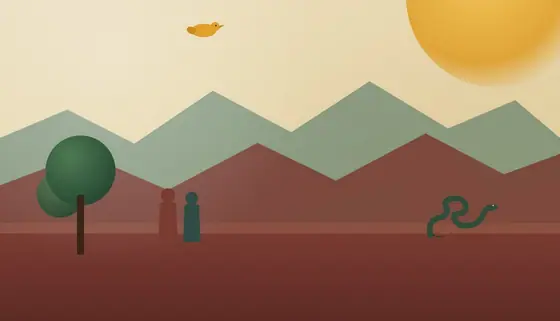
Photo: Pär Pärsson / Unsplash (Unsplash License)
ℹ️ This is an English translation of a Turkish oral folk tale. The regional dialect of the source text could not be fully preserved in translation. Read the Turkish original Bahtiyar Eniği’nin Donağı — Çubuk (Ankara) Masalı.
This tale is a folk tale collected in Çubuk, a district of Ankara. Told by Menekşe Tekleblebici, born in Çubuk in 1940, it was recorded in the master's thesis that Ayşegül Dirican prepared at Gazi University in 2023, titled "Çubuk Yöresi Masalları Üzerine Bir Araştırma 'Demonik (Olağan Dışı) Varlıklar'" (A Study of the Tales of the Çubuk Region: 'Demonic (Supernatural) Beings').
ℹ️ This is an English translation of a Turkish oral folk tale. The regional dialect of the source text could not be fully preserved in translation. Read the Turkish original here: Bahtiyar Eniği'nin Donağı — Çubuk (Ankara) Masalı.
Once there was, once there wasn't; God's servants were many1. There was a padishah, and this padishah had three daughters. All three daughters lived at home. One day the padishah said, "Let us go to the palace." The servant took them to the palace. They had a melon field, and the melons had ripened. The three girls were picking the melons. One of the girls said:
"Look, this melon here is mine2. That melon will be the middle daughter's, and that little one will be the youngest daughter's," she said.
They took the melons to their father and gave them to him. Their father asked:
"What on earth is this?"
The girl said:
"One melon's time is passing, one is just about ready, and one is the youngest girl's," she said.
The padishah understood that his daughters wanted to marry. He had a town crier call out and gathered all the people:
"My daughter, sit here, and we will let a bird fly," he said.
They let the bird fly. It went and landed on the head of a handsome young man, and the padishah held a wedding for the eldest daughter that lasted forty days and forty nights. They let a bird fly for the middle daughter, too, and the padishah held another forty-day, forty-night wedding for his middle daughter. The turn came to the youngest girl. Again they let the bird fly, and the bird landed on the head of a snake at the foot of a pine tree. "That doesn't count," they said, and everyone waited, each hoping it would land on his own head. They let the bird fly three times, and all three times it landed on the head of the black snake. The girl said:
"This is my fate, my luck. What can we do? Bring the snake, boil some milk and put the snake in it, and place it in my bedchamber to stay there," she said.
The eldest daughter's wedding began, and they put the snake in the bedchamber, and there it ate and drank. Jereed3 was being played at that time. The snake slipped out of the thread4 and became a young man as beautiful as the full moon. He mounted a white horse, put on white clothes5, and went off. The youngest girl hung her head and kept looking at the handsome men. Those beside her pinched her and said to her:
"You couldn't find a handsome man like that, and instead you found a snake and are looking after it."
The handsome young man who was playing jereed was in fact the youngest girl's beloved. The wedding ended, and the middle daughter's wedding began. At the middle daughter's wedding, too, the snake mounted a red horse and put on red clothes and became a handsome young man just like that. Jereed was played again. The youngest girl hung her head and wept again; she came home and saw the snake lying there. The young man would put on his snake guise before the girl came home. The girl lay down on her bed and wept. The maidservants brought the girl food. When the girl fell asleep, the snake ate the meal, shook himself and became a young man. At that moment he bent down to kiss the girl, and she at once seized him by the arm and asked:
"Who are you, and what are you?"
The young man said:
"Tell no one, for if you tell, my spell will be broken. I am the snake who lies over there," he said. "Tell no one, so that my spell is not broken."
The girl was glad. The snake said:
"It was I who rode the white horse and the red horse and played jereed," he said.
The turn came for the youngest girl's wedding. At the wedding, while jereed was being played again, someone pinched the girl and said:
"You didn't marry a handsome young man like that, you went and married a snake."
At that moment the girl said:
"Who says that young man isn't mine?"
The snake knew at once:
"Ah, coy Zeliha, you have wronged me and you have wronged yourself; my spell is broken," he said.
He became a bird and flew away. The girl went to her father and told him what had happened:
"The young man who rode the white horse was mine. I will go to him. I will put on horseshoes6. Give me gold by the camel-load, and I will go and find him," she said.
The girl set out. She had a bathhouse built in a corner. Anyone who wanted to tell her troubles would go into the bathhouse and tell what had happened to her. Keloğlan was herding someone's livestock. While he was herding, a bird came and hooked the pails7 onto its wing, and Keloğlan saw it as he was filling a jug at the fountain. He wanted to go and tell this to the girl. Keloğlan went to his mother and said:
"Mother, you are very dirty. Go into the bathhouse and wash, and I will tell my story to the girl," he said.
Keloğlan came to the girl and began to tell the story:
"I followed the bird to see where it was going. The bird went and set off behind the water, and, covering its face, it was weeping, 'Ah, coy Zeliha, ah, you wronged yourself and you wronged me,'" he said.
At that time a wedding of devs was taking place, and food was cooking. Keloğlan said:
"If I ate one ladleful of each, my belly would be full," he said.
He went to the food and was about to eat when the men said:
"Bahtiyar Agha, where do you think you are eating, before the meal8?" they said.
Ladles landed on his head, and they did not let him eat. Keloğlan came back and told this to the girl as well. The girl said:
"I give you this bathhouse for nothing; it is yours. But take me there," she said.
Keloğlan took the girl there, and she arrived. The girl went and hid behind the door. The food was cooking in great quantities. The wedding was almost over when a bird came, and when it said, "Ah, my coy Zeliha, you wronged me and you wronged yourself," the girl caught the bird. The young man slipped out of his guise9 and became human, and he said to the girl:
"Well, where am I going to hide you? When the devs wake up and smell you, they will kill you," he said.
One of the devs was the young man's maternal aunt. The young man went to his aunt. The aunt knew from the smell that there was a girl with him. When the aunt saw the girl, she began to torment her. After the young man had flown away, his aunt said to the girl:
"You will sweep one of these steps and leave another unswept," she said.
The girl did it, weeping. The aunt put a jar in front of the girl:
"You will fill this by weeping," she said.
When the girl wept, each drop dried up. When the young man came and asked, the girl told him, and the young man filled the jar with water. When the aunt came, the girl said, weeping, that she had filled it. The aunt said:
"Ah, this is not your doing, it is the doing of Bahtiyar Eniği10," she said.
The bird said to the girl:
"Let us run away," he said.
He took the girl and fled, and they came to a bakery. When the aunt woke up, she could not find Bahtiyar Eniği, and she said to her man:
"Go and find them."
The man set off along the road and came upon a bakery:
"Did a boy and a girl come by here and pass through?" he said.
The baker said:
"I did not see them," he said.
When the man went back to the aunt, he said:
"I could not find anyone. I came upon a baker, and there was a baker and a loaf of bread," he said.
The aunt said:
"That baker was the boy, and the bread was the girl. If you had seized the boy and brought him, the bread would have burned crackling," she said.
This time the young man turned into a snake and wound himself around a bush. The girl became the bush, and the young man became a snake. This time the young man's mother came:
"Ah," she said, "Bahtiyar's whelp, did you love this girl so much? May you come out of this form and, God willing, be unable to enter any other form," she said.
The young man came out of that form and could never enter another form again. He could not become a bird, and he could not become a snake. They wrote a letter in the language of birds and sent it to the girl's father. A bird came and tapped on the window of the padishah, her father11, and left the letter. When the padishah read the letter, the girl said:
"I have found Bahtiyar Eniği. Prepare forty camels; we are coming," she said. When they came to the palace, her father held a wedding for forty days and forty nights. And they reached their heart's desire.
Translator’s Notes
1. "Bir varmış bir yokmuş" ("once there was, once there wasn't") is the standard opening formula of Turkish folk tales, roughly equivalent to "once upon a time." The following phrase ("Allah'ın gulu çohmuş," literally "God's servants were many") is a common companion formula. ↩
2. The source phrase "Bak şu gavun benim bu olmuş" is unclear; "this melon here is mine" is the most probable sense, but the wording could not be verified. [verification needed] ↩
3. Jereed (cirit) is a traditional Turkic horseback game played with javelins. ↩
4. The source says the snake "iplikten sıyrılıp," literally "slipping out of the thread." The meaning is uncertain; by comparison with later passages ("donundan sıyrılıp") it most likely means that he slipped out of his snake form. [verification needed] ↩
5. "hurba" in "ak hurbaları" is a dialect word whose meaning is uncertain. Because the parallel passage says "gırmızı elbiseleri" ("red clothes"), "clothes" is the most probable sense. [verification needed] ↩
6. "Ayağıma nalları giyeceğim," literally "I will put horseshoes on my feet." The meaning is not clear; it may allude to the folk motif of a long journey in which iron shoes are worn out, but this could not be verified. [verification needed] ↩
7. "helke" is an uncertain dialect word; "pail" or "bucket" is the most probable meaning, since the character is filling water at a fountain. [verification needed] ↩
8. "Bahtiyar ağa yimeden nereye yiyon" is dialect and its sense is uncertain; the translation follows the most probable reading. "Bahtiyar" is used here as the young man's name or epithet. [verification needed] ↩
9. In this dialect "don" (and the form "donak" or "donağ" in the title and later passages) means a form or guise that a character takes on, such as that of a bird or a snake. ↩
10. "Bahtiyar eniği" appears in the title and in the aunt's and mother's speeches as an epithet or name of the young man. Literally "bahtiyar" means "fortunate, happy" and "enik" means "pup, whelp"; the exact sense could not be verified, so the Turkish phrase is kept as a name. [verification needed] ↩
11. The source reads "padişahın babasının camına" ("the window of the padishah's father"). From the context the padishah is the girl's father, and this is how it is rendered; the wording may be a slip in the source. [verification needed] ↩
Source
Dirican, Ayşegül. Çubuk Yöresi Masalları Üzerine Bir Araştırma "Demonik (Olağan Dışı) Varlıklar". Master's thesis, Gazi University, Institute of Educational Sciences, Department of Turkish and Social Sciences Education, Turkish Language and Literature Education Program. Advisor: Prof. Dr. İsmet Çetin. Ankara, 2023 (YÖK National Thesis Center, Thesis No. 844524), pp. 62-65. Narrator: Menekşe Tekleblebici (Çubuk, Ankara; born 1940; literate; housewife). Date of collection: not stated in the thesis; the thesis was completed in December 2023. Tale type number: the thesis gives no AaTh/ATU or EB classification number, and none is given here.
The Turkish text is given in the local dialect of Çubuk, with distinctive spellings and grammar (for example "gız" for "kız," "gavun" for "kavun," "dimiş" for "demiş"); this translation renders the story in standard English prose rather than attempting an equivalent English dialect. The archive's Turkish file marks the narrator, author, and place of collection as awaiting verification. The Turkish original is published in this archive as Bahtiyar Eniği'nin Donağı — Çubuk (Ankara) Masalı.


