The She-Cat and the Monk — A Japanese Folk Tale
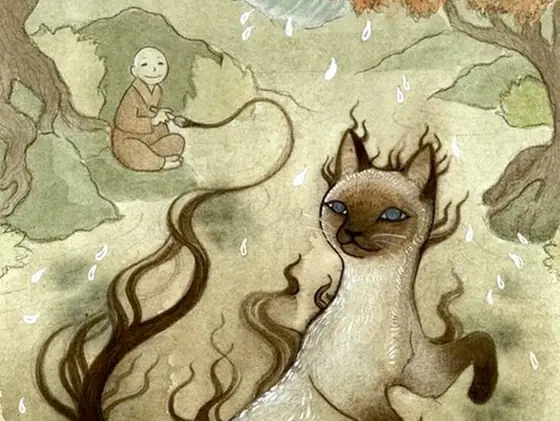
Photo: Jonathan Ikemura / Unsplash (Unsplash License)
ℹ️ This is an English translation of a Turkish oral folk tale. The regional dialect of the source text could not be fully preserved in translation. Read the Turkish original Dişi Kedi İle Keşiş (Japon Masalı).
The She-Cat and the Monk is a Japanese folk tale. It tells what happens to a wandering monk who gathers healing herbs in the forests and cures the sick with spells.
ℹ️ This is an English translation of a Turkish oral folk tale. The regional dialect of the source text could not be fully preserved in translation. Read the Turkish original here: Dişi Kedi İle Keşiş (Japon Masalı).
#### The She-Cat and the Monk (A Japanese Folk Tale)
Once upon a time there was a wandering monk who roamed from land to land from spring until winter. He gathered healing herbs in the forests, recited prayers at funerals, and with great success worked spells and cured the sick. When the patients he had cured offered to let him stay with them, he did not want to take advantage of their hospitality for long. After a few days the urge to go would come over him, and he would gather up his belongings and set out on the road. Of course, living like this was very hard in winter. But the monk always found a monastery in which to spend the bad season. When the sun began to warm the earth, he would set out wandering from land to land in his black robe, with torn sandals on his feet and an old bag on his back. Because he never stayed long in one place, people forgot him easily. Truly, no one knew him. As he reached an advanced age, he began to have great difficulty in meeting his needs. He slept wherever he happened to be. He could not even remember when he had last eaten a meal! Still, he did not mind any of this. He grew cheerful at the sight of the mountains and the sparkling waterfalls1. He got on very well with all the birds and the other animals. For him there was nothing better than walking along watching the white clouds in the sky.
One day his road led him to the town of Füküjima. In the marketplace he was wondering whom he could ask whether he might be put up for the night, when an elderly man said: "You must have come from far away," and went on, "for I have never seen you before."
"I am coming to your town for the first time. I was just wondering where I might spend the night. Could you give me some advice?"
"In our town you need not worry about that. Since you have come here for the first time, you cannot know what has been happening here. A great misfortune has befallen our judge. His only daughter is gravely ill, and no one can cure her. A great many doctors have come. They have come even from the capital. But not one of them found a remedy. A great many monks have recited prayers at the sick girl's bedside, all in vain! The girl just lies there. She does not say a word, she does not eat, she does not drink, and she wastes away from day to day. The judge has asked his neighbors to send any strangers who come to the town to his house. Perhaps one of them will know a medicine or make a useful suggestion, he hopes. Venerable monk, you must know about various illnesses. Would you not like to go there and try your luck?"
The monk listened carefully to the talkative man, then promised nothing about the outcome, but said that he would certainly go and see the judge's daughter.
To his question about where the judge's house was, the old man answered: "Go straight on. The last house on the left of the main street is the judge's house."
Following the directions, the monk went down the main street. As he came up to the house, a small spotted cat came out of a hole in the courtyard wall, crossed his path, and meowed:
"Venerable monk, wait a moment. I have something to tell you."
Surprised, the monk stopped and looked at the she-cat.
"Meow, I sense that you are a kind and compassionate person. In my grief I do not know what to do. Please, give me some advice. If you promise to help me, I will reveal something very important to you. I have lived in this house for a long time. I know why you have come to the judge's house. Whether you cure the young girl depends entirely on me."
The monk stroked the cat and promised to help as much as he could.
Then the she-cat went on: "The judge's daughter is not suffering from an ordinary illness. I made her ill in order to punish all the wrongs that have been done to me in this house. I have lived in this house for twelve years. Every year the judge has had my kittens drowned. Yet I want to have children. I want to raise them as they should be raised. Soon I will have kittens again. So I decided to take my revenge. If you make sure that my kittens stay alive, and if you take me away from here, the judge's daughter will recover; otherwise she will die."
As she looked at the monk, the she-cat's green eyes were shining brightly.
The monk was a little startled, but he understood the she-cat's pain very well. He promised her that he would help. Then he went up to the judge's house and called out, "Is no one here? I have come to see the patient."
The servants and the troubled father, along with the mother, pale and plainly worn by grief, came running. They took him at once to the sick girl's room.
A little girl lay in the bed. Her face was so pale that among the white coverings only her black hair could be made out. She lay motionless and unconscious. She seemed not even to notice the visitors.
"She has been like this for a long time. Until now not one doctor has been able to tell us what is wrong with her. Help us, venerable monk. Save our only child," the poor mother and father begged.
The monk bowed his head, took out his prayer beads, and began to pray.
"BO-RON, BO-RON, MİO-KO TEN Cİ KİU-TAİ SA-HO SO-Bİ-NEN ŞO-TEY KU-SAN..."2 The words of the prayer spread sweetly through the room. The mother and father watched their daughter's face intently. Suddenly a shy smile appeared on the pale face. As the monk continued his prayer, the patient sat up in bed and said in a very weak voice: "I am so hungry!"
The joy of the mother and father was endless. They embraced their daughter and had food and drink brought for her. With tears in their eyes they thanked the monk. They gave him the best room in the house. He tasted the most delicious dishes.
"Give me your spotted she-cat," the monk said to the parents. "I want no other reward."
The judge was surprised at the monk's modesty, but since he would accept nothing else, he at least filled his bag with rice dumplings and cakes. The monk took the she-cat, slung his bag over his shoulder, and left.
"If you do not want something like this to happen to you again, do not kill your she-cats' kittens," he advised the judge before leaving.
From then on the she-cat never left the monk's side. Wherever he went, she went with him. They did not always see good days, but the monk shared everything he had with the she-cat. When her kittens were born, he found an old abandoned temple near the village. He settled there with the she-cat and helped her to raise her kittens. Winter was approaching, and he could find very little food for himself and the she-cat. They never ate their fill. They did not even have wood to warm themselves with.
The monk thought long and hard, and one evening he said to the cat: "Dear cat, you see for yourself how poor we are. Winter is coming, and the winters here are very harsh. I have thought a great deal about finding a way out. But I could not find one. You must leave me. Because with me you will find nothing but hunger. Find a better master for yourself and your kittens. There are enough rich temples around. You are sure to find a good monk who will look after you. As for me, I will manage somehow."
The she-cat arched her back, purred sweetly, and watched her kittens playing in a basket with contentment.
"Meow," she answered in a low voice. "You need not worry about me, or about yourself. By saving my kittens from drowning you let me fulfil my greatest wish. You honestly shared the smallest scrap with me, even when your own stomach was empty. For a long time I have meant to reward this kindness of yours, but I did not know how to do it. At last a good idea has come to me. Listen to me well. At the cats' ball, to which all the cats of the region are invited, I have heard that the grandmother of the bean-sauce merchant3, the richest man in the region, will die in a few days. This will be a chance for me to help you. The rich man will summon all the well-known monks to bury his grandmother in a manner worthy of his name. After the prayers, when the monks want to lift the coffin to carry it away, I will raise the coffin into the air and hold it there without anyone seeing me. No power in the world will be able to move the coffin: not down, not forward, not back. The spell will be broken only when your turn comes to pray. But so that I can tell you apart from the other monks and release the coffin, you must slip a mention of cats into the middle of your prayer. Since all the prayers are unintelligible anyway, no one will notice. You alone will be able to lower the coffin onto the bier. Your fame will spread through the whole country. You will not have to beg to find food. You are no longer young. Wandering from land to land is not for you."
The monk shook his head doubtfully, for he did not really believe that the cat had magic power. But so as not to spoil the cat's pride, he did not object; on the contrary, he promised to do as she said.
And indeed, five days later the grandmother of the rich bean-sauce merchant died. The funeral had to be carried out with a ceremony worthy of her grandson, who was devoted and obedient and, besides, the richest merchant of the region. Even the best at reckoning could not have counted the monks and clergy who gathered! The embroidered coffin was placed on a raised wooden platform. From morning till evening, in the temple full of lights, the murmur of prayers and the rattle of prayer beads could be heard. The end of the funeral was approaching, and the monks were getting ready to lift the coffin to carry it away. Suddenly the coffin rose into the air and hung there, as though an invisible force were holding it. The monks tried to pull the coffin down but could not. At last they concluded that there was a spell on it.
The rich merchant and his family were seized with fear. Had they failed in some duty to their grandmother! Had they made some mistake! Such a spell could surely be broken by prayers. They promised that if the monks managed to bring the coffin down and finish the funeral properly, they would reward them richly.
The monks began to pray. They ran their prayer beads so fast that sparks flew from the wooden beads. But they must not have been saying the right prayer, because the coffin stayed where it was. Then each monk began to recite his own prayer in secret. Each insisted that his own prayer was the effective one. Then they began to quarrel, saying "your prayer is more effective," "no, mine is more effective." They almost came to blows. In spite of all this turmoil, no one managed to bring the coffin down.
The villagers came running and began to mock the monks. "This is not like eating pilaf, or secretly stuffing oily fish into your bellies. At that you are unbeatable. But come on, show us your skill and bring down that coffin."
"Just look at the state of those monks! Each one flew at the others, saying he knows the best spell. But they cannot even bring down a coffin."
Truly, though, the monks did all they could. Admitting defeat was no pleasant matter; but in spite of all the prayers, the coffin hung in the air.
At last the rich merchant's patience ran out. "We are disgraced! You have disgraced my venerable grandmother's funeral. Has such a thing ever been seen!" he shouted. He sent his servants to fetch all the monks of the region. If only they could bring down his grandmother's coffin, he would give them whatever they wished!
Monks came from all the temples and tried their luck. They all prayed in turn, in vain!
"Have you really called all the monks?" the rich merchant asked his servants.
"Yes, all of them without exception, master."
"It cannot be that there is no monk to be found to help us!" said the rich man, sinking further into despair. "Think carefully. Make sure you have not forgotten a monk."
One of the servants thought long and hard and then said: "We really did forget one," he said. "A little way off, in an abandoned, half-ruined temple, there lives a monk with a she-cat and her kittens. Considering that, for all his age, no one knows him and he lives in poverty, he is not worth calling. Will he succeed where so many famous monks failed!"
"Bring him quickly. We must try every possibility," ordered the merchant. The servants ran to the temple.
"You must have heard what has happened in my house," said the rich merchant. "Forgive me for not calling on you earlier. But hardly anyone in our region knows you. Please try to bring the coffin down. Let us finish the funeral properly. You are my last hope. The most famous monks have shown their skill, but no one has succeeded. If you manage to bring the coffin down, I will reward you richly, and I will have a new temple built for you."
Without a word the monk bowed and went to the courtyard where the coffin hung in the air. Hidden forces seemed to hold him back.
The monks gathered around the coffin mocked him. "Look at that poor wretch! He is going to do what we could not. We are truly curious."
The villagers also pointed at him with their fingers: "Look at him! That is the monk of the old abandoned temple. Did he know anything besides eating dumplings!"
"Just look at him! Does he look like someone who has eaten a lot of dumplings? Look how thin he is! His clothes are falling apart. Perhaps this monk knows far more than those fat monks who live in plenty."
The monk paid no attention to any of these words. As though they were not about him! He approached the coffin hanging in the air and began to pray:
"BO-RON, BO-RON, MİO-KO TEN-Cİ..." But the coffin did not move, KİU-TAÎ SA-HO KE-Dİ... and at that moment the coffin came down onto the bier.
Everyone drew a deep breath of relief. The rich merchant, still not at ease, ordered them to lift the coffin so that the funeral could go on; he feared the spell would continue.
But the coffin had truly become an ordinary coffin again. The monks set to work, and the relatives and guests formed a long procession. The grandmother was buried as she should be, in a manner worthy of the richest merchant of the whole region.
After the ceremony the rich merchant sent for the monk and asked him where he wished his temple to be built. But the monk did not want a new temple. He wanted his old, lonely temple, half ruined and half repaired, and he got what he wanted. The merchant brought a crowd of craftsmen: carpenters, carvers, painters and many other masters... The old temple gave way to a carved wooden temple with red-lacquered columns. Inside the temple there were many wooden statues of saints.
The new temple drew many monks. The monks built huts around the temple. Then a great monastery arose. The fame of the old monk, who was the abbot of the monastery, spread through the whole country because of the knowledge he had proved at the funeral. The temple became a place of pilgrimage. Besides the pilgrims, many merchants and craftsmen came as well. In a short time a town grew up around the monastery.
So the she-cat did not only help the old monk; many people also made homes for themselves in this town.
The old monk lived happily with his cat. Still, when spring came, he would leave the monastery for a while and wander in nature. He would enjoy the green of the mountains and the singing of the birds. Because his old legs no longer served him as they used to, he would quickly return home. Indeed, wandering from land to land was now very hard for the old man.
At the funerals he attended, he would recommend that the head of the coffin be adorned with a dragon's head.
"Who knows, a helpful she-cat may make trouble at a funeral just to do a good deed," he would murmur in a low voice.
Translator’s Notes
1. The Turkish word is "çavlan," which is not a standard word. It most likely stands for "çağlayan" (waterfall, cascade), but this could not be verified. [verification needed] ↩
2. The prayer is reproduced as it appears in the Turkish text, in its Turkish transliteration of what is presumably a Japanese Buddhist chant. It has not been checked against any Japanese source, and the transliteration may be inexact. [verification needed] ↩
3. "Fasulyeli sos" literally means "bean sauce." It may refer to soy sauce or miso, but the Turkish text does not say. [verification needed] ↩


