The Stepbrothers — A Turkmen Folk Tale
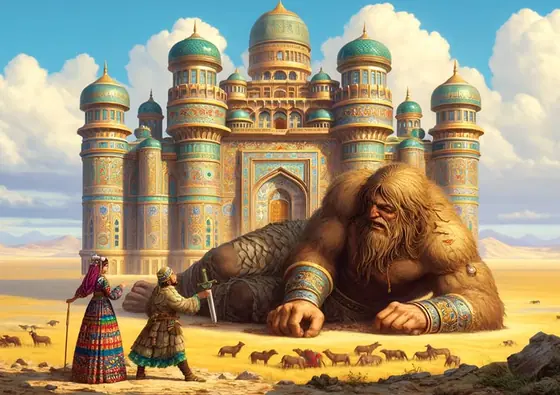
Photo: juan pablo rodriguez / Unsplash (Unsplash License)
ℹ️ This is an English translation of a Turkish oral folk tale. The regional dialect of the source text could not be fully preserved in translation. Read the Turkish original Üvey Kardeşler (Türkmen Masalı).
The Stepbrothers is a Turkmen tale; it tells a story that begins with a cruel order given to his pregnant youngest wife by a padishah named Leke Şah, who had ten sons by each of his eleven wives.
ℹ️ This is an English translation of a Turkish oral folk tale. The regional dialect of the source text could not be fully preserved in translation. Read the Turkish original here: Üvey Kardeşler (Türkmen Masalı).
#### THE STEPBROTHERS
Once upon a time a country had a padishah. They called him Leke Şah. He had eleven wives, and by each of his wives he had ten sons. His youngest wife was pregnant. Before she gave birth, the padishah went hunting. Before going, he gave his men this instruction:
"If after I am gone I have a son again, leave him in the desert with his mother. If it is a daughter, bring me the good news!"
Months passed, days chased days, the woman's time came, and the padishah's youngest wife had a son. The viziers and deputies, helpless, left them in the desert one night on the padishah's orders and went back. The helpless woman was left alone in the desert with her little child. Then, when she looked around, her eye fell on a great mansion. When she went up to the mansion, she saw that it was a large, square, tall mansion. It was the mansion of a great dev1. The woman and her child went inside. But a huge dev met them. The dev fought them, and they defeated the dev. Then they shut the dev up in the stone well inside the mansion. In this way they began to live in the mansion. One day the boy's mother took the dev out of the well. They secretly committed a sin. The woman had a son by this dev. One day the woman said to her son:
"My son, I found this little boy lying in such-and-such a place. There is no one for us but the two of us. Loneliness is a fault in a brave man. I brought him. But if you do not want this child, I will go back and leave him where I took him from," and with these words she persuaded the boy.
The boy was soft-hearted. So he said, "Loneliness is a bad thing. When this child grows up he will be a companion to me on the hunt, a confidant at home, and a brother in bad times," and said to his mother:
"All right, do not take him back. Feed him well and raise him."
The woman took what was needed and began to feed the child. One day she deceived the boy by saying:
"Look, my son, I nursed him. But now my milk has run dry."
Time passed; the dev and the woman decided to get rid of the elder boy and live in peace. The dev said to the woman:
"You will tell your son: 'I long to eat a melon; find me one, even a small one.' I have an old mother called Devmama2. She has forty ropes of melons3. When he goes there, my mother will kill him."
His mother repeated to her son exactly what the dev had said. The kind-hearted boy said nothing and went to look for a melon. On the way he came to a large building. A very beautiful girl was sitting there. When the boy asked the girl what she was doing there, the girl said:
"A dragon will eat me today. I am a padishah's daughter. There is a great misfortune in our country. A dragon comes and swallows a girl every day. If it cannot find a girl, it sends its men to the head of the water and has the water cut off, leaving the people without water. For this reason a girl has to be given to it every day. Today it is my turn. O brave one, do not stay here, flee. The dragon will be here at any moment."
The boy said:
"No, I am not going. I have only just come off the road and I am tired. Let me lie down and rest a little. When the dragon comes, wake me," and spreading his clothes on the ground, he lay down to one side. At one point the girl's tears fell on the boy's face, and recoiling in disgust, the boy woke. He saw that the ground was shaking because the dragon was coming, and that the air was filled with dust and smoke.
The boy got up, drew his sword and walked in the direction the dragon was coming from. When the dragon opened its mouth and headed for the house, he split it with his sword. The dragon was cut in two and died. After killing the dragon the boy said, "Let me rest a little more," and lay down and fell asleep. The girl sat beside him, stroking the boy's face. The next day the padishah sent men to get news of his daughter. The men came to the place where the girl was and saw the dragon cut in two and the girl sitting stroking the face of a brave young man. They carried this news to the padishah at once. The padishah came, took them, and returned.
The boy was entertained in the palace for forty days and became a friend of the padishah's daughter. Then the boy set out to take the dev mother's melons. The old woman called Devmama was an ill-intentioned dev mother. The boy also had two greyhounds. The greyhounds helped the boy and killed Devmama. The boy took the melon and went back. His mother was astonished to see her son come home safe and sound. The dev said to the woman:
"It did not work this time; you make some effort, tie his hands, and I will take care of the rest."
His mother tricked the boy and tied his hands. The dev came to the boy with his hands tied, gouged out his eyes, and they set him on a horse and left him in the desert. Seeing the boy in this state, the padishah's daughter recognized him and helped him. The girl found the boy's eyes, brought them back, and put them in place. The boy went after his mother and the dev. The greyhounds tore the dev and the woman to pieces and killed them. In the end the boy was reunited with the padishah's daughter, and they lived a happy life.
Translator’s Notes
1. A dev is a demon or ogre figure from the Persian-influenced storytelling tradition, distinct from the giants of European folklore. The word is kept in Turkish throughout, with "dev mother" ("dev anası") for the old female dev. ↩
2. "Devmama" is kept as it stands in the source and treated as the name of the dev's mother; the source also calls her "dev anası" ("dev mother"). ↩
3. The source says "kırk urgan kavunu" (literally "forty ropes of melons"). The meaning is uncertain: it may refer to melon vines or to a very large patch of melons. It is rendered literally. [doğrulama gerekli] ↩
Source
From the master's thesis Türkmen Masalları Üzerine Motif İncelemesi (Büyülü Masallar) ("A Motif Study on Turkmen Tales (Magic Tales)"), by Yusuf Ziya Sümbüllü; thesis advisor: Prof. Dr. Bilge Seyidoğlu; Atatürk University, Institute of Social Sciences, Department of Turkish Language and Literature, Erzurum, 2000.
Translated from the Turkish. The Turkish original is published in this archive as Üvey Kardeşler (Türkmen Masalı).


