


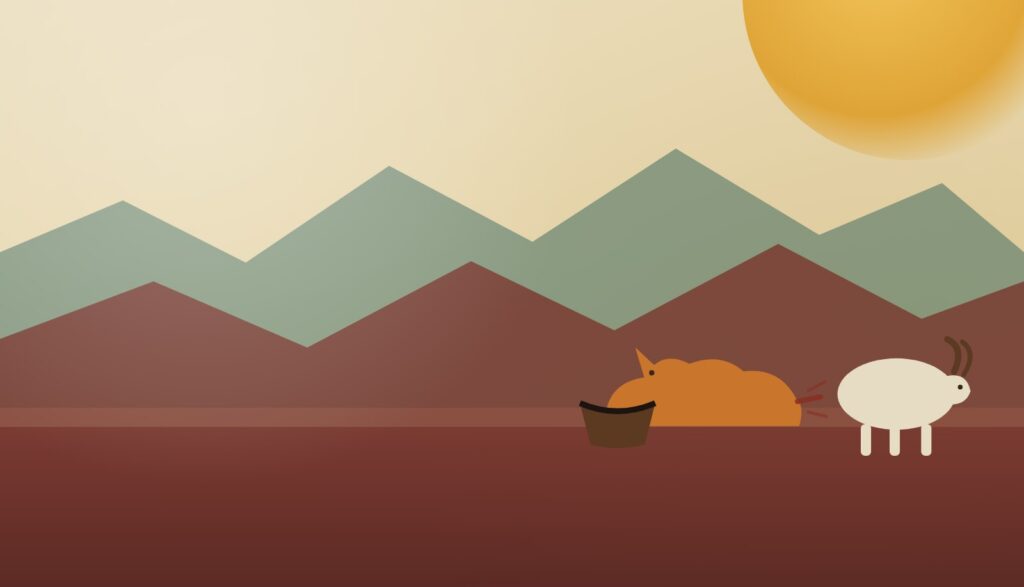
The Tailless Fox is a Khorasan folk tale — a chain tale, in which a fox who has lost his tail must go from creature to creature, each one asking for something else first, until the whole chain runs backwards and he gets his tail again.
ℹ️ This is an English translation of a Turkish oral folk tale collected in Khorasan. Some dialect words and formulas have no English equivalent and are explained in the notes below. The Turkish original is available here: Kuyruksuz Tilki (Horasan Masalı).
THE TAILLESS FOX
There was one, there was none. There was no one at all but God.1 There was an old woman and she had a goat. This old woman would milk her goat and carry the milk away and sell it, and so make her living.
One day a fox was passing by, and he looked: the old woman was milking the goat and putting the milk into a wooden bowl. And one side of the wooden bowl was broken. Later the fox comes and sees that, sure enough, the old woman has milked her milk and set it there. The fox drinks the milk at once and goes.
Then the old woman comes and sees that, sure enough, her milk has vanished. The next night it vanished too. The night after, she comes again and sees that, sure enough, the fox has drunk her milk. But the old woman was cunning. She fetches black pitch and smears it round all four sides of the wooden bowl. The fox comes and drinks the milk, and when he goes to leave, his tail is stripped clean off. Then he goes back among the foxes. The other foxes say:
“Hey, here comes gollo2 the fox — here comes gollo, gollo.”
The fox is disgraced. “What can I do to get my tail back from the old woman?” he says. “Let me go and ask her; perhaps I shall get it back.” Then he goes to the old woman and says:
“Grandmother, come now, do not be like this, give me back my tail.” Whereupon the old woman says:
“Very well, no one stands in the way of that. You give me back my milk, and I will give you back your tail.”
The fox goes to the goat and says:
“O goat, give me milk, so that I may take it to the old woman and she will give me back my tail.” Then the goat:
“Give me something — a leaf; fetch me a leaf from the tree, so that I may eat it and give you milk. And you take the milk to the old woman and get your tail back from her.”
Then the fox goes to the tree. The tree says:
“Go to the water, fetch water and give it to me to drink, so that I may give you a leaf. Take it to the goat, and the goat will give you milk; take the milk to the old woman, and she will give you back your tail.”
The water says:
“Tell the farmer to come and channel the water and carry it to the tree; and the tree will give you a leaf; and you give the leaf to the goat; and the goat will give you milk; take the milk to the old woman and she will give you back your tail.” Then the farmer says:
“Go and cook me an egg and bring it, so that I may eat it, and I will hold this water for you. Take it to the tree, and it will give you a leaf. Give the leaf to the goat, and it will give you milk. Give the milk to the old woman, and she will give you your tail.” Then the fox goes to the hen and says to her:
“O hen, give me an egg, so that I may take it to the farmer and he may eat; and he will give me water; and I will give the water to the tree, and it will give me a leaf; and I will give that to the goat, and it will give me milk; and I will take the milk to the old woman, and she will give me back my tail.”
The hen asks the fox for wheat. The fox goes to the grocer and asks him for wheat. Then the grocer says:
“Very well — upon my eye3 — I will give you wheat; take it and give it to the hen.”
The fox carries the wheat and gives it to the hen; the hen gives him an egg; he gives the egg to the farmer; the farmer eats it and is satisfied; he goes and channels the water for the tree; the tree gives him a leaf, and he carries it and gives it to the goat; the goat gives him milk; he carries the milk and gives it to the old woman; and the old woman gives him back his tail.
Then the fox goes back among the other foxes. The foxes say:
“Hey — how did this gollo get his tail back?”
Here our patience came to an end, and our tale is finished.4
Translator’s Notes
- The Khorasan opening formula, Biri vardı, biri yoktu. Hûdâdan başka hiç kimse yoktu, differs from the Anatolian one. Hûdâ is the Persian word for God, and its presence marks the tale’s place in the Persian-speaking world in which these Turkic communities live. The rhyme is lost in English; the sense is kept. ↩
- Gollo means “tailless” in the Khorasan Turkic dialect the tale was collected in. It is not standard Turkish, and the collector glosses it in a note of her own; it is kept here in the original because the other foxes are using it as a jeering nickname, and a plain English “tailless” would lose the taunt. ↩
- Göz üstüne, literally “upon my eye” — a formula of willing consent found across Turkish and Persian, roughly “gladly, with pleasure.” The literal form has been kept because it is the grocer’s one flourish of courtesy in an otherwise brisk exchange. ↩
- The closing formula of the tale as collected: Burada sabrımız sona erdi, masalımız ise bitti. Unlike the Anatolian “three apples” ending, this one closes by admitting the teller’s patience has run out — a joke about the chain-tale form itself, which could in principle go on forever. ↩
Source
Tulu, Sultan. Horasan’dan Masallar ve Halk Hikâyeleri. Ankara: Ürün Yayınları, 2005.
Translated from the Turkish. The Turkish original is published in this archive as Kuyruksuz Tilki (Horasan Masalı).