The Tale of the White Flowers and the Red Flowers — A Tebriz Folk Tale
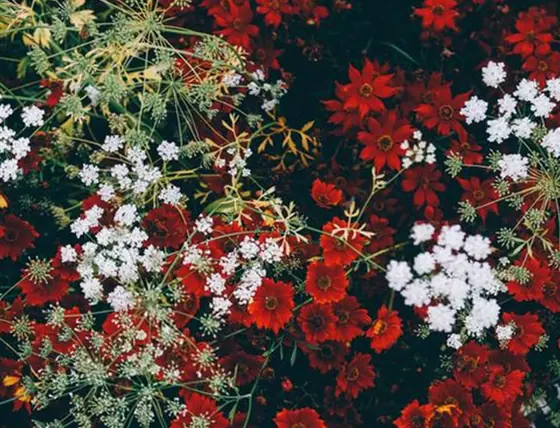
Photo: Seth Reese / Unsplash (Unsplash License)
ℹ️ This is an English translation of a Turkish oral folk tale. The regional dialect of the source text could not be fully preserved in translation. Read the Turkish original Beyaz Çiçeklerle Kırmızı Çiçeklerin Masalı (Tebriz Masalı).
The Tale of the White Flowers and the Red Flowers is a tale from the Tebriz region; it is a symbolic story about the white and red flowers of a vine in a garden.
ℹ️ This is an English translation of a Turkish oral folk tale. The regional dialect of the source text could not be fully preserved in translation. Read the Turkish original here: Beyaz Çiçeklerle Kırmızı Çiçeklerin Masalı (Tebriz Masalı).
#### The Tale of the White Flowers and the Red Flowers
There was one, there was none1. In a garden there was a very beautiful creeping vine2. The vine had very beautiful white and red flowers. The vine trailed down to the ground. Its lush green leaves cast shade on the earth. Its red flowers gave off a lovely fragrance. Children played in its shade and took great delight in the sweet scent of the flowers.
Among the red flowers there were also white flower buds. But the children had never seen the white flowers open. One day they talked about it. Little Ayten said:
"When these white buds open, they become red flowers."
Her brother Orhan said:
"Then what are these red buds?"
Her other brother, Togay, said:
"Come, let us pick the white buds. Let us see whether they turn red or not."
Orhan said:
"No, we must not pick the buds. If we do, the vine will take offense at us and will not bloom any more."
One night Orhan woke from his sleep. In the light of the moon the courtyard (heyet: a garden closed on all four sides, an inner courtyard) was shining as bright as day. Orhan looked out of the window and could not believe his eyes. It was as if snow had fallen on the ground beneath the vines. Snow-white flowers had opened on the branches. In the morning he talked with his sister Ayten and with Togay. The children came running at once. But only red flowers had opened on the branches. The white buds were closed. Laughing, Ayten and Togay said to Orhan:
"So where are the white flowers, you liar?"
Orhan said:
"But I saw them with my own eyes. The white flowers had opened."
Ayten said:
"You must have seen them in your dream."
Orhan was about to say something when suddenly the vine found its voice:
"Children, Orhan is telling the truth. My white flowers open at night, my red flowers by day."
The children asked at once:
"Well then, why? We want to see the white flowers too."
The vine said:
"Then let me tell you the tale of the white flowers and the red flowers."
There was one, there was none. In the forest there was a gray nightingale. The nightingale had built her nest among the yellow, sweet-smelling blossoms of an oleaster tree3 whose leaves shone like silver. She had four chicks. One day bird catchers came to the forest. They set traps and nets in the branches of the trees, among the boughs, and caught birds. They were looking for the chicks of the gray nightingales. They wanted to take the chicks of the gray nightingales away and put them in a cage. The gray nightingale saw the bird catchers drawing near. She wanted to deceive them and lead them away from the nest. She flew up at once and settled on a low branch. From there she flew down and landed in the grass. The bird catchers were walking, and the nightingale, pretending to be wounded, fluttered her wings among the grass and dragged herself along the ground, moving farther away. The bird catchers did not stay behind and began to run after her. The nightingale drew them away from her nest. When the nightingale tried to fly, one of the catchers cast a net and caught her. The catcher shouted:
"Oh my! I've got her!"
The fearless nightingale pierced the catcher's hand with her beak. The catcher let the bird go because of the pain in his hand:
"Ouch, ouch, ouch, my hand!"
The poor nightingale, who had fallen in the net, was wounded. With the last of her strength she flew and threw herself into the vine. Weeping, she said:
"My poor chicks, who will feed you now? Who will protect you?"
Hearing this, the vine said:
"Do not be afraid, nightingale, we will look after your chicks."
Stretching out its branches, the vine wrapped itself around the tree where the chicks were. It wound around the nest and bloomed there with white and red flowers.
The nightingale's chicks saw the flowers and were glad. The flowers gave the chicks sweet sherbet in their own little cups. They told them lovely tales. They did not let them go hungry, they did not let them be bored. For a while, in turns, the red flowers by day and the white flowers by night gave the nightingale's chicks sherbet and told them tales. After a few days the mother nightingale recovered and came to her chicks. She thanked the vine's flowers very much. She raised her chicks and made them fly.
Children! Ever since that time the red flowers of the vines open by day and the white flowers by night.
Translator’s Notes
1. "Biri vardı, biri yoktu" ("there was one, there was none") is the standard opening formula of Turkic and Persian-influenced folk tales, roughly equivalent to "once upon a time". ↩
2. The source phrase "sarmaşık yolu" (literally "ivy road/way") is unclear. It is understood as a creeping or climbing vine and rendered "vine" throughout; the exact plant is uncertain. [verification needed] ↩
3. The "iğde" is the oleaster or Russian olive, a tree with silvery leaves and small, sweetly scented yellow flowers. ↩
Source
Note: This tale was recorded in a studio in the Iranian city of Tebriz by a woman storyteller, to light musical accompaniment and intended for children, and was published on an album of folk narratives in Iran. The compact disc of the album was acquired by us during our collecting work in Iran.


