The Two Thieves — A Cretan Folk Tale
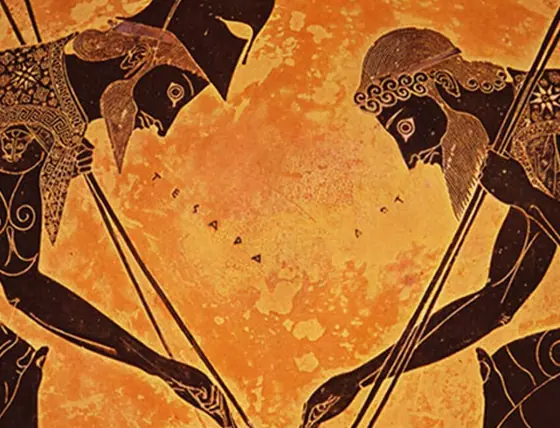
Photo: Carmen Roman / Unsplash (Unsplash License)
ℹ️ This is an English translation of a Turkish oral folk tale. The regional dialect of the source text could not be fully preserved in translation. Read the Turkish original İki Hırsız (Girit Masalı).
The Two Thieves is a folk tale from the island of Crete. It tells of the meeting of two thieves, one from Constantinople (Istanbul) and one from Crete, who set out to find out which of them is the more skilled.
ℹ️ This is an English translation of a Turkish oral folk tale. The regional dialect of the source text could not be fully preserved in translation. Read the Turkish original here: İki Hırsız (Girit Masalı).
#### The Two Thieves (A Cretan Tale) — Muzip Masal Cini
Once there was, once there was not1. There was a thief from Constantinople (Istanbul), and there was another thief, a Cretan. They were famous men, and each of them wanted to meet the other and so find out which of them was the better. One set out from Constantinople and the other from Crete. They met at a fountain.
"Who are you?" one of them asked.
"I am a Cretan, and I have set out to meet a famous man from Constantinople," said the other.
So the ice was broken, and each understood that the other was a famous thief too.
By the fountain there were trees, plane trees. A crow had built a nest there among the branches. The Constantinopolitan thief climbed the tree to steal the crow's eggs. One after another he took the eggs from the nest and put them in his pocket.
The Cretan followed him at once, and as the other climbed down he took the eggs from his pocket and put them in his own. Then he untied the Constantinopolitan's shoelaces and took them away without being noticed.
The Constantinopolitan came down from the tree and put his hand in his pocket to show the eggs to the other, but the eggs were not there.
"They are here," said the Cretan, and then he asked the other:
"Tell me, haven't your shoes lost their laces?"
The other looked at his shoes; the laces were gone.
"Friend," he said, "I am good, but you are better than I."
So they decided to go to Constantinople and make their business bigger. The Constantinopolitan thief was married. They set to work. Once they stole a loaded camel from a caravan that was passing in front of the Constantinopolitan's house. They hid it at once.
The police gave the people who had lost the camel this advice:
"Put a cross mark at the place where you lost the camel. We will look there to find it." The caravan men made a cross on the door of the house at the place where the camel had vanished. Seeing this, the Cretan made the same mark on the doors of all the houses. Now which one would the police search? After this the two thieves went to the king's treasury chamber. They drove large nails into the wall and used them as steps, and so they were able to climb up. The first night the Cretan entered the treasury chamber, stole whatever he fancied, and came down again through the same window. He pulled out the nails one after another and filled the holes with plaster, so that nothing showed any more.
Because of this the authorities sought the advice of an old thief whom they had caught and blinded. They told him what had happened. The old thief said:
"If you had not gouged out my eyes, I could have caught him and brought him to you. But now I can only give advice. Put a pot of tar where the thief gets in. He will stick to the tar and will not be able to steal. That way you can catch him."
They put the pot of tar under the small window and went away. When night fell, the thieves came again. The Cretan said to the Constantinopolitan:
"Tonight you go in. I was there yesterday."
The Constantinopolitan climbed up, fell into the tar, and stuck fast. The Cretan waited and waited outside, but the other did not come.
"What has happened? Can they have caught him?" he thought.
Carefully he climbed up to the window, leaned in, and asked in a low voice:
"Friend, what has happened? I have been waiting for you for a long time."
"I am an unlucky man. I fell into the pot of tar. I am stuck here and I can never get free."
When the Cretan understood that he could not free him from there, he drew his knife and cut off his accomplice's head. Then he went to his friend's wife and said:
"Oh, poor woman, oh! This is what happened tonight."
In the morning the king's men went to the treasury chamber and found the thief without his head.
Again they turned to the old thief and told him what had happened. The man gave them this advice:
"The thief has an accomplice. Take the body you have found to the great square, and when his wife comes and begins to weep for him, arrest her."
The king's men followed his advice. The dead thief's wife wanted to go to the square where her husband lay and weep for him. But the Cretan said to her:
"If you do that, they will arrest you. I will get you a peddler's tray full of trinkets. You will pretend that you want to sell that junk. As you pass your husband's body, you will stumble and fall, and the junk will break. You will wail over the broken glass, and so you will have wept for your husband."
The woman took the peddler's tray full of glassware and went through the streets trying to sell it, crying, "Fine glass, fine glass!" When she passed the body on display, she dropped her tray just as the Cretan had told her, and the glass broke into a thousand pieces. The woman cried out and began to tear at her hair.
"Oh, what has befallen me, oh, what has befallen me!" she wept. When she had wept enough, she went away. In the evening the blind thief asked:
"Did anyone come to weep?"
"No one came to weep for him. Only a poor woman carrying a peddler's tray of trinkets stumbled, and what was on her tray was scattered on the ground. She wept over that."
"Well, then, that woman was the thief's wife."
The blind thief gave the king this advice:
"Issue an amnesty proclamation for the thief, guaranteeing that you will not kill him. One day it may be of great use to you."
The king issued the decree in question. The Cretan thief now felt safe. He entered the palace, gave up thieving, and began to make his living there.
A neighboring king was saying that the king of Constantinople was not even in a position to catch a single thief, and he mocked him.
Then the old Cretan thief said to the king:
"My king, if you permit it, I will steal that king who says such things to you and bring him to you. But for this I need a great many chicken wings."
They brought him the chicken wings he wanted, and from them he made himself a garment of many-colored feathers. The king gave him a ship, and the old thief set out for the other king's country. When he arrived, he went straight to the palace. Whatever he told the people in the palace, God knows what, they let him in to the king. The king was sleeping at the time. The old thief put on his feathered garment. He knocked at the king's door and woke him. Seeing this strange creature before him, the king was frightened.
"God has sent me to take your life!"
"For God's sake, let me go!"
"No, it cannot be done. God has sent me to take you. The only kindness I can do you is to take you to Him without taking your life."
The king agreed to this. The old thief found an old chest, hid him inside it, and warned him sternly:
"Whatever you hear, do not make a sound."
The Cretan thief brought the chest to the ship, and they sailed back by the same route. Beforehand, the two of them had agreed on a signal with the king. When the king saw that the signal had been given from the ship, he understood that the thief had completed his task successfully, and he gave the order for the cannons to be fired.
The king inside the chest asked:
"What is this?"
The old thief answered:
"God is thundering because I have brought you alive."
Then they arrive at the palace and open the chest, and there is the foreigner2. They bring the king out. The host king says to him:
"So you mocked me because I could not catch one thief! Look how that thief stole you and brought you here!"
That is how the tale ends.
Translator’s Notes
1. "Bir varmış bir yokmuş" ("once there was, once there was not") is the standard opening formula of Turkish folk tales, roughly equivalent to "once upon a time." ↩
2. The Turkish sentence reads "Sonra saraya gelirler, sandığı açarlar ve yabancı." and appears to be incomplete. It has been rendered as "and there is the foreigner" (that is, the kidnapped king); this is a best guess at the intended meaning. [verification needed] ↩
Source
From the collection Girit Masalları (Cretan Tales) by Maria Amariotu, translated into Turkish by Ümit Yüksek. Bilgi Yayınları, 1987.
Translated from the Turkish. The Turkish original is published in this archive as İki Hırsız (Girit Masalı).


