


This tale was collected in the Karaman region of Turkey. It was told by Vahap Aras (born 1945 in Karaman, primary-school educated) and recorded by Filiz Münüklü on 17 February 1989, now held in the archive of the Selçuk University Turkish Folk Culture Research and Application Center. The text was published as an appendix (Ek-1) to Vahdi Özer’s article “Vladimir Propp’un Masal Çözümleme Metodu Bağlamında ‘Sarı Öküz’ Masalı Üzerine Bir İnceleme” (“A Study of the Tale ‘Sarı Öküz’ [The Yellow Ox] in Light of Vladimir Propp’s Method of Tale Analysis”).
ℹ️ This is an English translation of a Turkish oral folk tale. The regional dialect of the source text could not be fully preserved in translation. Read the Turkish original here: Sarı Öküz — Karaman Masalı.
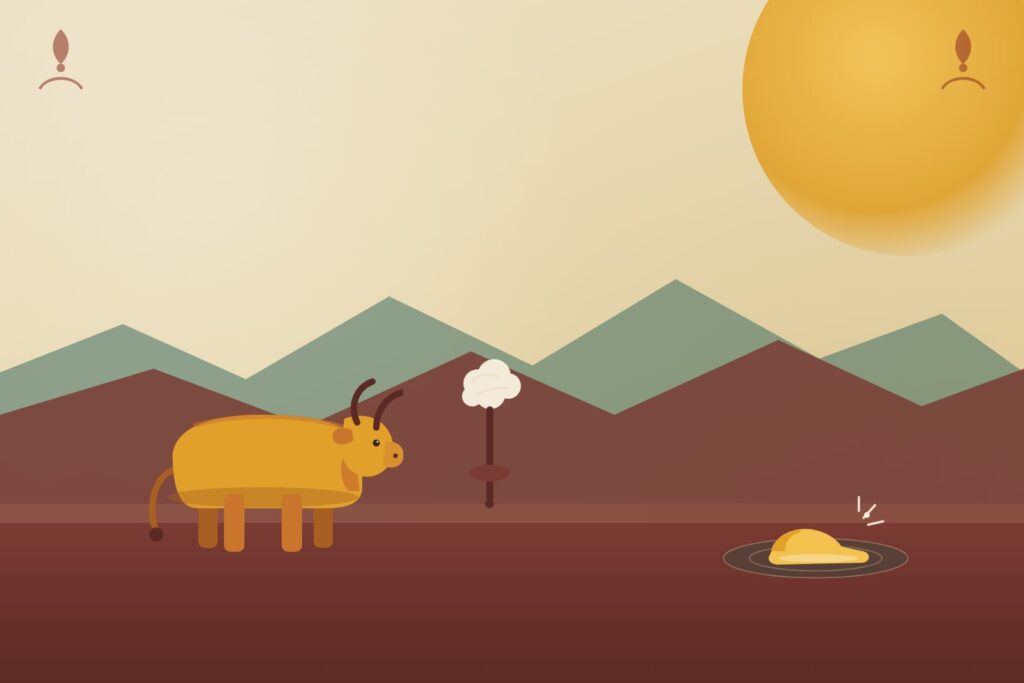
Once upon a time, in the days of yore, there lived a modest family, living out their quiet life. As time went on, this family also kept a yellow ox. One day the mistress of the house passed away, and the little daughter was left motherless, an orphan.
Her father sent the girl to study with a woman teacher. While the girl was being taught, this teacher — whose own husband had died — set her eye on the girl’s father. She said to the girl:
“If I marry your father, I’ll see that you’re taught even better, and make scholars of you all.”
The teacher had a daughter of her own too. That girl went to her father and begged him: “Father, if you marry my teacher, she’ll teach us better and make scholars of us,” she pleaded.
Unable to bear his daughter’s pleading, the father asked for the teacher’s hand, and they married.
Some while after the wedding, a rift grew between the two girls. The woman favored her own daughter and kept her to light chores, while she drove her stepdaughter to the harder work, doing everything in her power to wear the girl down.
Then one day she set the yellow ox before the girl and said: “Go on, my girl, take this up the mountain and graze it nicely” — and put a bundle of dirty wool in her hands, telling her: “Wash this wool, dry it, spin it, and bring it back spotless by evening.” The girl took the yellow ox and went up the mountain. As she struggled to wash the wool by a stream, a white-bearded old man appeared beside her. Knowing the girl’s plight, he took the dirty wool from her hands and gave her clean white wool instead, saying: “My girl —
“Go and spin this wool. Your spindle will snap on the mountain, roll away, and enter a cave. There is a giant in that cave. Mind you don’t suckle from his left breast — suckle from his right,” he warned her.
And with that the old man vanished. As the girl spun her wool on the mountain, the spindle snapped. It rolled away, and the girl followed it… The spindle rolled into a cave. She looked, and there was a giant, asleep. She went and suckled at his right breast. At this the giant woke.
“Well, well,” he said.
“A little lamb has come. She has suckled my right breast — she has become my child,” he said.
“My girl, take a look at my head, won’t you,” he said.
The girl looked at the giant’s filthy head, laid her hand upon it, then kissed her own hand, telling him what a fine head he had. And she asked his leave to go.
“Let me take my leave — I must go,” she said.
“My girl,” he said, “there’s pickle in the jar, and bread over there. Take some and eat.”
The girl opened one jar and found it full of snakes and scorpions. She opened the other and found only moldy bread…
“Very well,” she said. “I’ve taken it — farewell,” she said.
At this the giant said to her:
“Listen, my girl — on your way you’ll come to three fountains. The first runs white. The second runs black. The third runs red,” he said.
“Wash yourself in the white one. Rub the red on your lips and cheeks, and the black on your hair, brows, and eyes,” he told her, and sent her on her way.
The girl went on and found that indeed there were three fountains along the road, just as he’d said. She washed in the white fountain. She rubbed the black on her brows, hair, and eyes. She rubbed the red on her cheeks and lips. The girl became a beauty beyond compare. Driving her yellow ox before her, she came straight home and knocked at the door. When it was opened, what did they see but a girl of unearthly beauty standing there? They were astonished at the sight. And the next day, the stepmother sent her own daughter out to graze the ox in just the same way — clean wool in her hands to spin, food and drink for the road, telling her to graze the ox and bring it home again by evening. As she went along the way, the same old man appeared once more:
“My girl,” he said.
“On the road your spindle will snap, roll away, and enter a cave. There is a giant in that cave. Mind you don’t suckle his left breast — suckle his right.”
“Very well,” said the girl.
The spindle snapped and rolled into a cave, and the girl followed it in. She looked, and there was a giant lying inside. She went straight up and suckled his right breast. The giant said, “Well, well.”
“What lamb is this that’s come? She has suckled my right breast — she has become my child. My girl,” he said, “take a look at my head.”
“Ugh — your head is filthy, lice-ridden. I won’t touch it,” she said.
“Then I’ll be going,” she said.
“My girl, since you’re going, there’s pickle in the jar, and bread over there. Take some of that too and eat,” he said.
She looked and found the jar full of snakes and scorpions, and the bread all moldy. “I won’t eat that,” she said. The giant gave her the very same counsel he had given the first girl:
“On your way you’ll come to three fountains — one runs white, one runs red, one runs black. Wash in the black one, rub the white on your brows and eyes, and the red on your lips and cheeks,” he said. Wanting to become beautiful, the girl followed the giant’s counsel exactly and went on her way. She washed in the black fountain. She rubbed the white on her brows and eyes. And when she rubbed the red on her cheeks and lips, she turned into the very image of a monkey. Believing herself made beautiful, she drove the yellow ox before her and came straight home. When her mother eagerly ran to open the door, what did she see but a girl looking like something out of a dungeon? Seeing her in such a wretched state, she was aghast.
“This can only be the yellow ox’s doing,” she said.
“I must find some way — I must see to it that this ox is done away with,” she brooded to herself.
And that evening she pretended to fall ill. When her husband came home:
“Oh, husband, I’ve fallen ill — I’m dying! Find some cure for what ails me,” she said, and when her husband asked her:
“Wife, what is the cure for your ailment?”
“If you slaughter the yellow ox, I’ll be well again. There’s no other way I can recover,” she said.
The girl, overhearing this from behind the door, ran straight to the stable, threw her arms around the yellow ox’s neck, and began to weep and weep… And a voice came to the yellow ox from God, saying:
“Mind you don’t weep. Take my head, my feet, my entrails — all of it — put them inside my hide, and bury it in a corner of the stable,” it said.
“This meat — my meat — will be sweet to you and your father, but bitter to your stepmother and her daughter. They will not be able to eat my meat; you shall eat it, but they shall not,” it told her.
And so they slaughtered the yellow ox. Just as it had said, the girl put its head, its feet, and its entrails inside the hide, and buried it in a corner of the stable. Some time later, the household was invited to a wedding in the neighborhood. Though they all wished to go, the stepmother wanted to take only her own daughter to the wedding. To her stepdaughter she set out a cauldron under the sun, saying:
“You are to fill this cauldron with your tears. When I come home, I’ll knead dough and bake bread with them,”
she said. The young girl bent over the cauldron in the sun and began to weep… The drops falling from her eyes vanished into the hot cauldron. A neighbor’s daughter noticed and asked:
“Why are you crying?”
“If I don’t cry, who will? My stepmother has ordered me to fill this cauldron with my tears. When she comes home she’ll make bread with them,” she said, at which
the girl replied: “What could be easier than that?”
They filled the cauldron with water, threw in some salt, and the cauldron was full.
“Come, let’s go to the wedding too.”
“If my stepmother sees me there’ll be no end of it. Besides, I have no clothes fit for a wedding, no shoes,” she said — and as she spoke, she remembered the yellow ox’s feet, entrails, and hide. She said:
“I could go to this wedding disguised as a bald boy. Then no one will know me.”
She dug up the hide from where she had buried it in the stable, and what did she find? The hide had become a magnificent robe, embroidered all over in gold; the entrails had become pearls and necklaces; the feet had become splendid shoes. She put all this on and went to the house where the wedding was held. Being beautiful to begin with, she now became a beauty beyond compare.
The whole crowd forgot the bride and turned to stare at this girl. Everyone looked at her. Indeed, they lifted her up to dance. As she danced, gold scattered on every side. While the onlookers scrambled to gather it, one piece happened to fall to her own stepmother among the crowd. Saying she was late, the girl slipped away. As she hurried home across a bridge, one of her shoes fell off and dropped into the water below. She took the rest and went home, burying them again in the stable — but the one shoe was lost in the water and could not be recovered. When her stepmother came home, she said to her stepdaughter:
“So you think you’re beautiful too, do you? Today at the wedding there was a girl far, far more beautiful than you — everyone looked at her, and as we danced gold was scattered all around. See, I caught a piece myself,” she said, taunting the girl. The girl paid it no mind. When the sultan’s son came to that same stream to water his horse, the horse would not go near the water. He noticed a glimmer beneath the surface… He said to his men and viziers:
“Whatever that glimmering thing is, fetch it out.”
They lifted the golden shoe out of the water. The sultan’s son said to his servants and soldiers:
“Whoever’s foot this shoe fits, her I shall marry,” he commanded. The soldiers who took the shoe began going from house to house throughout the land, but the dainty shoe fit no one — too small for some, too large for others, and for some it would not go on at all. So they went from door to door, until at last it was this house’s turn. The stepmother, hoping to force the shoe onto her own daughter’s foot, filed her feet down — but still it would not fit. And when they asked whether there was anyone else in the house, they had shut away a girl named Fatma Hanım inside the clay oven, so that no one would see her. A rooster came and began to crow on top of the oven — cock-a-doodle-doo! — Fatma Hanım is in the oven!… Hearing this, the soldiers pulled Fatma Hanım out. And what did they see but a girl as lovely as the full moon on its fourteenth night. They slipped the shoe onto her foot — for the shoe was hers — and it fit exactly. “We’ve found the shoe’s owner,” they said. “What now?”
“Bring her,” he said.
They took Fatma Hanım and brought her to the palace, and preparations for a wedding began. Some time later, the girl was brought before the sultan’s son, and she told him everything, exactly as it had happened. The sultan’s son then said to his new mother-in-law:
“Would you rather have forty mules, or forty knives?” She answered:
“Oh, my lord, what would I do with forty knives? Give me the forty mules, so I may ride to see my husband’s family and come back again to your side.” At this the sultan’s son had forty mules made ready — to twenty he gave no water, to twenty he gave no fodder, keeping them hungry and thirsty by turns for two or three days. Then, bringing the mules out into the open, he set fodder on one side and water on the other, mounted his mother-in-law upon them, and bound her by the feet to all forty. When the hungry mules rushed for the fodder and the thirsty ones for the water, the mother-in-law was torn in two between them.
They held a wedding for forty days and forty nights. May they attain their heart’s desire — and let us rise from our seats.
Source:
Özer, V. (2022). Vladimir Propp’un Masal Çözümleme Metodu Bağlamında “Sarı Öküz” Masalı Üzerine Bir İnceleme [A Study of the Tale “Sarı Öküz” (The Yellow Ox) in Light of Vladimir Propp’s Method of Tale Analysis]. Karamanoğlu Mehmetbey Üniversitesi Edebiyat Fakültesi Dergisi, 5(2), 251-266 (Appendix Ek-1: Tale Text, p. 263). DOI: 10.47948/efad.1182617
Narrator: Vahap Aras (b. 1945, Karaman; primary-school educated)
Collected by: Filiz Münüklü (17 February 1989, Karaman)
Archive: Selçuk University Turkish Folk Culture Research and Application Center