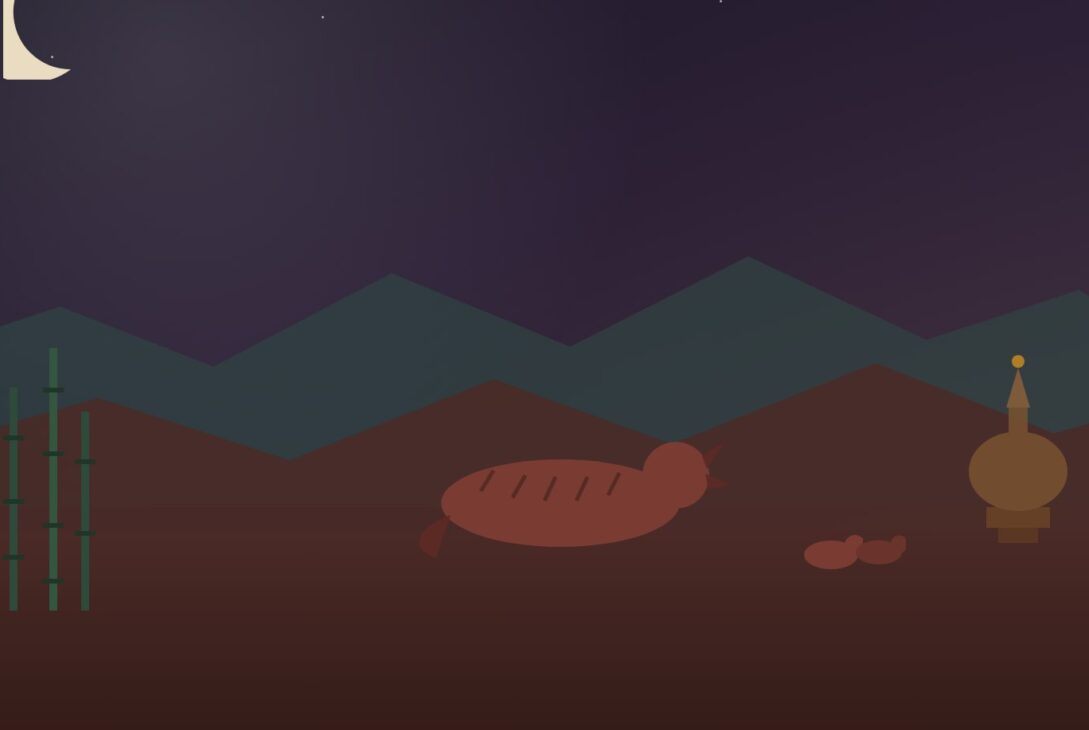
An Old Uyghur Buddhist tale from the Altun Yaruk Sudur: three princes come upon a starving tigress in the forest, and the youngest gives up his own body to save her and her cubs — the story known in the wider Buddhist tradition as the Hungry Tigress jātaka.
ℹ️ This is an English translation of an Old Uyghur Buddhist tale (a jātaka, or past-life story of the Buddha) preserved in the Altun Yaruk Sudur. Sanskrit and Buddhist terms are kept close to the forms used by the source text, with explanations given in the notes below. The Turkish original is available here: Aç Bars Hikâyesi (Uygur Masalı).
This text belongs to the folk-narrative tradition. It is the Hungry Tiger story found in Chapter 26 (the tenth book) of the Old Uyghur Altun Yaruk Sudur1 — between folios 6 and 15 of that tenth book. It is originally a Sanskrit text, translated into Chinese in the eighth century and, probably in the eleventh century, into Old Uyghur by Şingko Şeli Tutung2. Because the Old Uyghur version contains additions made by its translator or later copyists, it is more detailed than the Chinese text. This edition follows the St. Petersburg manuscript of the Altun Yaruk Sudur. All of this information, and the text itself, is taken from Zemire Gulcalı’s master’s thesis, later published as a book, Eski Uygurca Altun Yaruk Sudur’dan Aç Bars Hikâyesi (“The Hungry Tiger Story from the Old Uyghur Altun Yaruk Sudur”). The thesis presents the text in verse form together with a linguistic study; here it is rendered as continuous prose.
THE HUNGRY TIGER
In ancient times, in this world of Jambudvīpa3, there lived a ruler named Maharatha. This King Maharatha was exceedingly wealthy: his storehouses were full of grain and goods, and he commanded a superb army of heroes and archers. He had brought the lands on every side under his rule and was honored by nearly all; he always led his people by just law and teaching, increased the population all around him, and cleared every quarter of enemies. Born to this radiant, majestic and mighty king, from his chief queen, were three sons of pleasing appearance and handsome face. The eldest son’s name was Mahabala. The middle son’s name was Mahadeva. The youngest son’s name was Mahasattva4.
One day the king went out with his three sons to the countryside, to the forest, for recreation. Having arrived and enjoyed themselves there, the three princes asked their father’s leave to stay behind and gather flowers and fruit. Wandering here and there, they entered a large, dense bamboo grove and sat down to rest.
As they sat resting, the eldest prince said to his two younger brothers:
“My dear younger brothers, today I feel a great fear inside me — that there might be fierce, wild beasts in this forest, and that we might perish and come to harm.”
The second prince said:
“Listen, my brother — I would not at all begrudge giving up this body of mine; I fear nothing but the pain of being parted from those we love.”
Hearing this, the third prince, Mahasattva, said to his two brothers:
“This is a place where holy ones dwell — I have no fear at all, nor any anxiety of parting; rather my body is filling with great joy. Shall we find still greater merit here?”
Speaking together in this way of what was on their minds, the three princes rose and went deeper into the forest. Walking on, they came upon a tigress that had just given birth; seven days had passed since this starving tigress had whelped, and her seven cubs surrounded her — she, worn out and weakened by hunger and thirst, her body exhausted, her strength spent, lay there close to death.
Seeing this, the eldest prince, Mahabala, said:
“Ah, poor tigress — seven days since she gave birth, her seven cubs surrounding her, wanting food and finding none. Worn down by the torment of hunger and thirst, she is now on the point of turning back and eating her own cubs. Could there be a more wretched creature than this?”
Hearing this, Prince Mahasattva asked his elder brother:
“What does this tiger eat — what is its ordinary food?”
His elder brother answered:
“The food of the tiger, the lynx, the lion, the wolf, wild beasts in general, and the tişki5 — is nothing but warm flesh and blood; there is no other food or drink that could revive this weakened, starving tigress.”
Hearing this, the second prince, Mahadeva, said without thinking:
“This tigress, so weakened, so exhausted, so hungry, worn down utterly by the torment of hunger and thirst and now close to death — who but ourselves could show her fitting food and drink? Who could give up his own body for this poor creature, and so keep her alive?”
The eldest prince then said to Mahadeva:
“My brother, it is hard to give up wealth; it is hard to give up work and possessions — but nothing is as hard as giving up one’s own life.”
As soon as this was said, Prince Mahasattva spoke:
“My brothers! We are all of us now utterly attached to our own lives, our own bodies — but do we not, after all, have eyes wise and clear enough to see what would benefit another? There are indeed those blessed souls of the highest compassion who forever give up their own bodies for the benefit of living creatures.”
Having said all this to his brothers, he then thought to himself:
“And this body of mine — through a hundred thousand states of being it has been worthless and useless, decaying all this while; it has never had the least value, and has never brought the least benefit. How, then, should I not, on a day such as this, find at last a fitting use for it — casting aside this foul-smelling, needless body like discarded spittle or mucus, and become a hope, a refuge, for this poor starving tigress?”
Thinking in this way, and having spent this time in conversation with his brothers, all three felt compassion for the tigress, each in his own heart, and pitied her. But among them it was Prince Mahasattva above all who watched closely the tigress’s hunger, her weakness, her suffering — circling around her, never taking his eyes off her, gazing at her intently for a long while; then he stopped looking, and turned to walk on with the others.
Then, as Mahasattva Bodhisattva walked on, he thought again:
“Now, just as I have been thinking, the time has come for me to devote my body, my life. And why? Because from time without beginning I have trusted in this foul, bloody, festering, unlovely, repulsive body; I have worshipped food and drink, clothing, house and home, horses, elephants, carriages, beasts of burden, jewels and wealth — yet because this body is by its nature subject to decay and ruin, it has always decayed, always rotted; however I tried to protect it, to cherish it, I could never once keep it from ruin; however I labored to nourish this body, it has, like a wicked enemy, again and again destroyed and defeated me, made me wretched, and rendered my strength futile. Therefore it must be understood thus: the body is unstable and impermanent — of no use even to oneself, and for that reason as fearsome as an evil enemy; repulsive and unclean, like a heap of filthy dung. Therefore let me today make use of this body for one great, extraordinary deed: let me become a boat upon the ocean of Samsara6, and pull myself free of the whirlpool of birth and death.”
And then, at once, he thought further:
“If I now give up this body, I will thereby leave behind countless sins, boils, pus, blood, sickness and fear, every one of them; and besides, this body is filled with thirty-six kinds of filth — as unstable as foam upon water, a place where every kind of vermin swarms and blood and pus collect, bound together by bones wrapped in sinew, a thing utterly repulsive in its making. Therefore this alone befits me now: to give up my body and seek the highest, unsurpassed, eternal Nirvana; to drive away sorrow, anxious thought and suffering entirely; to bring the cycle of birth and death to an end; to sever the bonds of craving; to strengthen the power of dhyāna7; to complete perfect training and goodness without lack; to perform a hundred meritorious deeds; to seek out the root of all wisdom; to bear witness to the sublime, divine body praised by all Buddhas; to gladden the children of all living beings in the five worlds with prayer, charity, almsgiving and blessing.”
Having thought all this through in detail, Prince Mahasattva rose to his feet with firm resolve, filled with great longing and great compassion, and, easing his heart, thought of his two elder brothers:
“Whatever they may feel, let them not be afraid, and not stand in the way of what I intend.”
And so he said to his two brothers:
“Go on a little ahead — I will catch up with you at once.”
Begging leave of his brothers in this way, Prince Mahasattva left them and turned back alone into the forest, to the starving tigress. Quickly he took off his clothes, hung them on a bamboo branch, and spoke these solemn words:
“I now, without hesitation, out of great compassion, for the sake of the supreme and perfect Buddhahood of all living beings in this world, give up this body I love; I seek Buddhahood that knows no decay, no ruin — the sanctity of Buddhahood cherished and chosen by all the wise. May I draw living beings out of the suffering sea of the three worlds, set them free, and bring them happiness.”
Having spoken thus, the prince lay down before the starving tigress and offered himself to her; but because of the radiance of his great, compassionate heart, the hungry tigress would not touch him to eat him. Seeing this, the Bodhisattva climbed to a high place and threw his body down. The moment he struck the ground, the Bodhisattva thought once more:
“But this tigress, in her weakness and exhaustion, cannot eat me.”
Then the Bodhisattva stood up, looked around, searched for a knife but could not find one; then he took a dry, hard bamboo stalk and thrust it into an artery, into the vein of his neck, drew blood, and slowly approached the tigress. When he drew near her, this heavy, great, dark earth shook in six ways; as though a great wind had struck the surface of a lake and set it heaving, the earth was tossed up and down and churned; the sun in the sky grew dark and pale, colorless, as though swallowed by Rahu8, and every quarter grew utterly dark, wrapped in black smoke; heavenly flowers with the scent of musk fell from the sky, filling the forest with blossoms. Then the gods above, seeing this, were greatly astonished, and, rejoicing at so extraordinary a birth-legend of the Bodhisattva’s9, praised him and sang this verse:
“You have become a great being, a refuge for living creatures,
through your great, compassionate heart;
you look upon all beings as equal,
as if they were your own son, your own daughter.
With your keen strength,
your joyful, generous and sacred heart,
by giving up your body
you deliver living beings from suffering.
Your merit is beyond reach —
you shall surely attain it:
the eternal, true, perfect estate.
You shall pass forever beyond the tight bonds of birth and death;
in a short time you shall reach the peerless glory of Buddhahood;
without hesitation you shall bear witness, and find happiness.”
Then, as soon as the hungry tigress saw blood flowing from the Bodhisattva’s veins, she licked the blood and ate all his flesh, so that only the bare bones remained.
Meanwhile, the Bodhisattva prince’s elder brother, seeing the earth tremble, said to his younger brother:
“The black earth is trembling all over, the rivers along with the mountains — everywhere has gone dark, without light; this is surely a sign that our brother has offered up his body.”
Hearing this, his younger brother said:
“I heard the sincere words Mahasattva spoke with such compassion. When we saw that weak, starving tigress a moment ago, tormented by hunger, about to eat her own cubs, I already suspected our brother — whether he might have sacrificed his body.”
At that, the two princes, their hearts aching, cried out and wept; then at once they turned back, weeping, to the place where the tigress had lain. When they arrived, the younger brothers saw Prince Mahasattva’s clothes still hanging on the bamboo branch, his bones scattered and mingled with his hair, his spilled blood kneaded with the earth like mud and clinging to the ground. Seeing this, they threw themselves upon the bones and collapsed, overcome. After a while they came to themselves, lifted their hands, cried aloud, and lamented, saying:
“You were our gentle, good and virtuous brother, beloved — you had made yourself dear to our mother and father, our brother; why did you leave us, why did you not come back with us, the three of us who set out together? When our mother and father see us and ask, what shall the two of us answer them? It would have been better if the three of us had died together — we have no need at all for our own bodies to remain alive.”
The two princes, weeping and lamenting in this way, grew weary, and after a while they left that place at once.
Meanwhile, Prince Mahasattva’s own servants were saying to one another:
“Our prince is late — where has he gone? Come, let us go and look for him, and see what has become of him.”
At that same hour, his mother the queen, lying asleep in a high tower in the city, had a terrible dream: in it, her breasts were being cut through from deep within, her back teeth were falling out of her mouth, and three young pigeons were being chased by a hawk — one was caught, and the other two fled in fear. As she lay dreaming this, the trembling of the earth startled her awake. The moment she woke, she cried out in fear and dread:
“What can be the cause of this now? The black earth trembles so; the rivers and lakes overflow; the trees shake; the light of the sun has grown dim, as though veiled; my eyes, my breast are twitching — it was never like this before; it is as though an arrow has struck my heart, I am wracked with anguish, my whole body trembles, I have no peace left at all. The sign of the dream I saw is an evil one — can there be some passing, terrible danger?”
At that moment, milk began to flow of itself from both her breasts, and seeing this she wept all the more.
At that time, one of the queen’s maidservants, standing outside, overheard someone passing by say: “The prince has been searched for, and still not found.” Hearing this, the maidservant grew afraid and hurried at once into the palace, and said to the queen:
“My queen, have you heard? There is such a rumor outside — that they have searched for the prince and still not found him. What can this mean?”
Hearing this, the queen was seized at once with great anxiety, overwhelmed with grief, and with tears filling her eyes she went straight to the king and said:
“O great sovereign, I have heard word of this kind — what can it mean? Or have we lost our beloved, the apple of our eye, our youngest son Mahasattva?”
Hearing this, the king was startled, and, overcome with sorrow, wept, saying:
“O grief, O grief! Have I lost my beloved child this day?” And wiping away his tears, he comforted his wife, saying: “My dear, do not grieve at all — I will go out at once with everyone, and search for my beloved children, and learn whether they live or not.”
Saying this, he at once went out of the city together with all his commanders, and they scattered in every direction, going everywhere to search for the child. Before this had finished being said, a commander came hurrying up to the king and said:
“Great sovereign, please do not grieve — the two princes are safe and well; only the youngest, Prince Mahasattva, has not yet been found, and is being searched for.”
Hearing this, the king drew a deep breath and said:
“O sorrow, O sorrow. I have lost the child dear to my heart. When my son was newly born, my joy was small; then, on losing my son, my grief has become great — if only my son could return to me safe and sound, I would not grieve even if I died.”
Hearing this, the queen, her heart filled with sorrow as though struck by an arrow, cried out and said:
“My three sons10 all went off together to the forest to play, together with their servants — if the youngest, my beloved son, does not come back and remains alone, some parting calamity is sure to have befallen him.” So she lamented.
At that moment a second commander in turn came up to the king, and the king said to him:
“Commander, how is my beloved son Mahasattva?”
Hearing this question, the commander’s eyes filled with hot tears; weeping with grief, his mouth went dry, his tongue clung to his palate, and he could not speak, could not answer, and stood in silence. Seeing this, the king and queen asked in haste:
“Speak quickly, commander! Where is my little son, how is he? My heart is burning, as though on fire; I have lost my senses and my reason, I am at a loss what to do — do not break my heart, do not shatter it!”
Then the second commander related to the Bodhisattva prince’s parents, in full and careful order, everything that had happened — how the Bodhisattva prince had given up his body.
Hearing this, the king and his wife, unable to contain their grief, cried out and wept. Wishing to see the place where their son had died, they mounted at once a carriage drawn by swift horses and rode to that bamboo grove. When they arrived at the place where the Bodhisattva had given up his body, they saw the Bodhisattva’s fresh bones scattered here and there, and at once threw themselves to the ground and collapsed, as a great tree, struck by a strong, harsh wind, is felled; they lost their senses and their reason, and no longer knew what to do. Then the commanders and the ministers around them sprinkled cold water on them and fanned them, and at last brought the king and his wife back to their senses. As soon as they came to themselves, they raised their hands, cried out, and lamented, saying:
“How hard it was, my little one, my beautiful life — how could the torment of death come so soon, and seize you, and take you? If only I had died before you, my sun, we would never have had to see such great grief, such torment.”
Then, a little after, the king’s wife recovered from her swoon, and, her hair disheveled, striking her breast with both hands, rolling on the ground like a fish thrown out of water and writhing in the hot sand, she wept and said:
“Who was it that cut down the body of my beloved child — alas, his remaining bones lie scattered everywhere; I have lost my young one, my beloved child; crushed beneath this grief, can I no longer move at all? Who was it, alas, that killed you, my beloved child, that gave rise to grief and torment such as this? My heart is no hard diamond — how, then, does it not shatter, does it not break, and yet endure so? In my dream I saw this sign clearly: I saw both my breasts cut through together at the root; I saw my back teeth falling out; I have seen clearly this hour of torment. And I saw here, too, another dream: three young pigeons — a hawk chased all three, cornered them in one place, and, seizing one, carried it off. Now I have lost my youngest, my beloved little one — the outcome of this evil sign has proved no lie at all.” So she wept.
Then the king, together with his other two sons, weeping and grieving, and all the assembled lords, without removing their ornaments, gathered up all of the Bodhisattva’s remaining bones and held a great funeral procession to see him off; and when the funeral rites were completed, they enshrined him within a stupa11.
Translator’s Notes
- The Altun Yaruk Sudur — the “Sutra of Golden Light” — is a Mahayana Buddhist sutra, translated into Old Uyghur in Central Asia; it is one of the major surviving works of Old Uyghur Buddhist literature. ↩
- Şingko Şeli Tutung is the named translator of the Old Uyghur version of the sutra. ↩
- Jambudvīpa (Çambudivipa in the source text) is the Buddhist cosmological name for the continent inhabited by human beings — used here simply to mean “the world.” ↩
- This story is a jātaka: a tale of one of the Buddha’s own past lives. “Mahasattva” (“great being”) is both the youngest prince’s given name in this telling and a Buddhist epithet, which is why the text begins calling him “Bodhisattva” once he resolves to sacrifice himself. In the wider Buddhist tradition this episode is known as the Hungry Tigress jātaka; the source text’s own phrase for the sages’ dwelling-place (“evliyaların bulunduğu yer”) uses an Islamic-tradition word for saints, rendered here more generally as “holy ones.” ↩
- The Turkish source text lists tişki among the predator names alongside the tiger, lynx, lion and wolf. Its exact meaning could not be verified, so it is left untranslated here, following the source. [doğrulama gerekli] ↩
- Samsara: the Buddhist and Hindu concept of the cycle of birth, death and rebirth. ↩
- Dhyāna: meditative concentration; the root of the word “Zen.” ↩
- In Indian mythology, Rahu is a demon associated with eclipses, said to swallow the sun or moon. ↩
- The source text’s wording here (“olağanüstü doğum efsanesinden dolayı”) is not entirely clear — it may refer to the miraculous signs marking the Bodhisattva’s act as a kind of spiritual “birth.” It is translated literally rather than interpreted further. [doğrulama gerekli] ↩
- The source text reads “Üç avrum” (“my three avrum”) at this point, where context (the three princes) makes “my three sons” the clear intended meaning; “avrum” does not appear to be a standard Turkish word and is likely a transcription anomaly in the source. Translated here as “my three sons.” [doğrulama gerekli] ↩
- A stupa is a mound-like Buddhist monument built to house relics, typically the remains of the Buddha or another revered figure. ↩
Source
Gulcalı, Zemire (2013), Eski Uygurca Altun Yaruk Sudur’dan Aç Bars Hikâyesi, Ankara: TDK.
Translated from the Turkish. The Turkish original is published in this archive as Aç Bars Hikâyesi (Uygur Masalı).