The Vizier of the King of the Monkeys — From Kalila and Dimna
ℹ️ This is an English translation of a Turkish oral folk tale. The regional dialect of the source text could not be fully preserved in translation. Read the Turkish original here.
This tale comes from the Kalila and Dimna cycle, in the Turkish rendering of Sadık Yalsızuçanlar. It concerns a community of monkeys living on an island of endless plenty, and the vizier of their king.
ℹ️ This is an English translation of a Turkish text. Read the Turkish version here: MAYMUNLAR PADİŞAHI’NIN VEZİRİ.
The Vizier of the King of the Monkeys (Kalila and Dimna)
Once upon a time monkeys lived on an emerald-green island. On the island there was a plenty that knew no end and no exhausting. All manner of fruit trees, fruits and vegetables bursting out on every side had drowned the island in abundance. Rivers, waterfalls and cold springs gave them endless beauties to live among, as though it were a corner of paradise. The monkeys were very happy.
One day their leading men had gathered and were speaking of fruits one could never have one’s fill of the taste of.
Grapes, figs, hazelnuts, bananas, peaches, oranges — and what else besides. A bear that was passing by, seeing them gathered together, pricked up his ears at what they were saying. He was astounded at what he heard. While they were swimming in such plenty and abundance, the bears were living out their lives up in the mountains among wild thorn-bushes. Was this not an injustice? The bear ran and told the king of the bears everything he had heard, one by one. His appetite too was whetted. They gathered a great army and moved to lay siege to the island.
The ruler of the monkeys had gone out hunting that day. His viziers were with him as well. The bears left not one stone upon another on the island. Not a house of the monkeys was left unwrecked, not a possession of theirs unburnt. All of them were put to the sword, one by one.1 Down to the women and even the children, they were savagely killed. When news of the matter reached the king of the monkeys, the poor creature all but died of grief. He gathered those of his men who were still alive. They debated what was to be done. He had a clever, knowledgeable vizier.
He it was who stepped forward:
“My lord,” he said, “even if the whole body of the monkeys had risen to resist them, we still could not have got the better of them. The right thing is to resort to a stratagem. I wish to take this grave duty on myself. I wish to play them a fine trick.”
At first the king would not consent to this:
“No,” he said. “I do not want to lose you as well.”
The vizier said:
“I have already lost what there was for me to lose. My wife and my children have been killed. My country has been laid level with the ground. Either I take our revenge or I die. In this state, to stand with my hands tied is worse than death; give me leave and let me go.”
The king, having no help for it:
“Very well,” he said, “since you wish it, do as you know best.”
The vizier said to them:
“As for you, go to such and such a place and hide yourselves.”
And he daubed himself all over with red blood. He pulled out his fur. He seared some parts of his body.2 Stumbling and falling, he made his way towards the place where the bears were. The sentries seized him and brought him into the presence of the king of the bears.
The vizier said:
“I had gone out hunting with the king. I heard too late of your coming to our island, my worthy lord. Afterwards I was very angry with those who had stayed behind. Why, when the king of the bears honours our country, do you not receive him with a ceremony befitting his glory? Why do you not enter his service?
“When I said this, they fell upon me all at once. Calling me traitor and coward, they knocked me about; they very nearly killed me. I got out of their hands with great difficulty. Now I am the fiercest enemy the monkeys have. I know the place where they are; let me take you there, and destroy them all!”
The king of the bears had been taken in by these words.
“Good,” he said, “it is just the moment to tear the monkeys up by the roots. You go on before us and act as our guide.”
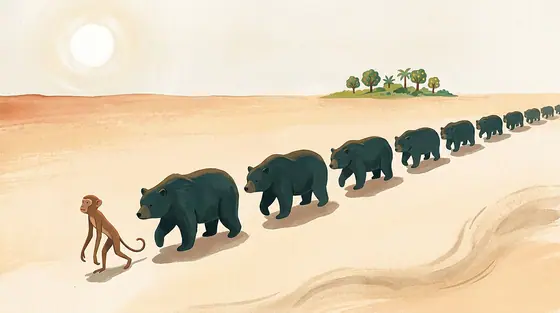
The monkey vizier, playing the cunning one further still, said that his leg was broken and that he had difficulty walking. A bear took him on its back, and they set out on the road. Deceiving them, the monkey vizier led them into the desert. For days they walked, hungry and thirsty. They had grown very weak. They had no strength left to take a step. They began to moan, “A single drop of water!” Just at that moment, would a poisoned wind not get up!3 The bears had realised they had been tricked. But it was too late for anything.
“And what is this wind?” asked the king of the bears.
The monkey vizier hid nothing any longer:
“O tyrant!” he said. “Do you not know what it is? It is the poisoned wind that kills whatever comes before it in an instant, that sweeps it clean away. After all the torment you inflicted on my tribe, even this is too little. I too shall die. But I go to the hereafter with my conscience at ease.”4
And the poisoned wind wrapped the bears about all at once and laid them all out on the ground.
Not a living thing was left behind.
Translator’s Notes
On the source. Kelile ve Dimne is the Turkish name of the collection known in English as Kalila and Dimna: a cycle of animal fables of Indian origin, descended from the Sanskrit Panchatantra, carried into Middle Persian and then into Arabic by Ibn al-Muqaffa’, and attributed in the Turkish and Arabic tradition to the sage Beydeba (Bidpai). Unlike the oral tales in this archive it is a literary text with a long chain of translators, and this English version stands at the end of that chain: Sadık Yalsızuçanlar’s Turkish rendering is what has been translated here, not any earlier text. The archive’s record for the tale names the publisher and the Turkish translator but not the title or date of the edition, and that gap is marked rather than filled.
1. The narration is in the plain Turkish past tense (-di) rather than the reported -mış past that marks the oral folk tales elsewhere in this archive. The difference is audible in Turkish and amounts to a claim about the kind of text this is: an account given as fact, by a writer, rather than a tale passed along by hearsay. English cannot mark the distinction, and nothing has been substituted for it. ↩
2. Dağlamak is to cauterise or brand — to burn the flesh deliberately. The vizier’s self-wounding is the whole of his stratagem: his body is the evidence for his lie, and he makes it himself before setting out. The tale spends one short sentence on it. ↩
3. Zehirli rüzgâr, “the poisoned wind.” The hot killing desert wind is a fixture of the region’s lore and language — the samyeli or simoom, held to strike down whatever it passes over. The tale gives the vizier no weapon and no army: he supplies only the walk, and the desert does the rest. ↩
4. Ahirete vicdanım rahat olarak gidiyorum — “I go to the hereafter with my conscience at ease.” Ahiret is the Islamic afterlife, and the line places the fable’s justice beyond this world: the vizier dies with the bears and counts the account settled. It is the closing judgement of the tale and there is no formula after it, only the bare sentence about the dead. ↩
On the frame. In the Kalila and Dimna cycle a tale of this kind is normally told by one animal to another inside a larger conversation, as an argument about how a ruler should act. The Turkish text in this archive gives the tale on its own, without that frame, and the translation follows it; readers should not assume the opening and closing lines are where they stand in the fuller collections.