The Basil Girl — A Kazdağı Folk Tale
ℹ️ This is an English translation of a Turkish oral folk tale. The regional dialect of the source text could not be fully preserved in translation. Read the Turkish original here.
“The Basil Girl” is a folk tale of the Kazdağı region, recorded from the narrator Şerife Nine in Sarı Kız ve Kazdağı Masalları, prepared by Cansever Eyüboğlu. It tells of three sisters left destitute by their father’s death, and of the dream that changes their fortune.
ℹ️ This is an English translation of a Turkish oral folk tale. Read the Turkish original here: FESLEĞENCİ KIZ.
The Basil Girl (Kazdağı Folk Tales)
There was one, there was none.1 In times long past, on Kazdağı,2 an old farmer lived together with his three daughters. The father and his daughters loved one another dearly, and they were living on happily when one day the old farmer fell ill and died. His daughters wept for days on end after their kind-hearted father. What is there to be done? In the end the poor girls were left behind in want and poverty.
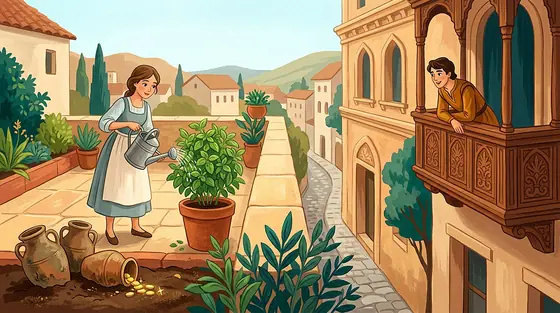
One night the youngest girl saw in her dream that nine jars of gold lay buried at the foot of the basil tree in the garden.3 At first she paid little heed to it, but when she saw the same dream several nights more she told her sisters.
The three sisters rolled up their sleeves at once and dug at the foot of the basil, and nine jars of gold did indeed come out of the earth. Embracing one another for joy, the sisters carried the jars into the house at once.
The three sisters had a fine house built for themselves. They set the garden in order too, and moved the basil across to it.4 Their new house stood opposite the palace. Every day they began to go down to their garden in turn and water the basil.
From the palace balcony that looked out over the garden, the padishah’s son would watch the three sisters with curiosity.
One evening, while the eldest girl was watering the basil in the garden, the padishah’s handsome and clever son called out to her:
“Basil girl, basil girl! Every evening you water the basil — how many leaves has the basil got?”5
The girl, partly out of shame and partly because she did not know the answer, ran straight indoors. The next day the middle girl came out to the garden and began to water the basil.
The padishah’s son threw out the same words to her as well:
“Basil girl, basil girl! Every evening you water the basil — how many leaves has the basil got?”
The middle girl too was ashamed, like her elder sister, and ran indoors without answering.
On the third day the youngest girl came out to water the basil. The moment the padishah’s son saw the girl in the garden he asked again:
“Basil girl, basil girl! Every evening you water the basil — how many leaves has the basil got?”
The youngest girl, who was very clever and quick-witted, answered the padishah’s son at once:
“You have become a lord and a pasha — you look out of the window at night; how many stars are there in the sky?”6
The padishah’s son was so struck by the clever answer he had been given, and by the beautiful girl, that he fell in love with her on the spot at first sight. And inviting her to the palace, he made known his wish to marry her.
A wedding feast was held for forty days and forty nights.7 The happiness of the prince and the basil girl lasted a whole lifetime. And the basil tree too grew up lovingly in the garden of love.8
Translator’s Notes
1. Bir varmış bir yokmuş — “there was one, there was none,” the standing Turkish opening, here in its shortest form, followed by evvel zaman içinde, “in times long past.” The fuller version of the formula, with its rhyming nonsense tail, appears in other tales in this archive. ↩
2. Kazdağı is the massif in north-western Turkey known to antiquity as Mount Ida, the mountain of the Judgement of Paris. The name has been left in Turkish, as the archive’s regional category for these tales is Kazdağı. The collection the tale comes from is named after Sarı Kız, a figure of the mountain’s own legend; her name has likewise been left untranslated. ↩
3. The Turkish calls the plant fesleğen ağacı, “the basil tree,” twice — once when the gold is buried at its foot and once in the closing line — and plain fesleğen, basil, everywhere in between, though basil is a herb and the thing being watered every evening by a girl in a garden is plainly a potted or bedded plant. The wording is the storyteller’s and has been kept. Basil carries weight in Turkish domestic life out of all proportion to its size: grown in pots by the door and on balconies, offered to guests to rub between the fingers, and associated with warding off ill. Nine jars of gold buried at its root is a reward placed at the root of the household’s own luck-plant. ↩
4. Göçürmek is to move a plant with its roots to a new place — the sisters take the basil with them when they move house, which is the point: the plant is treated as part of the family’s fortune rather than as garden stock. ↩
5. The prince’s call is a teasing rhyme — Fesleğenci kız, fesleğenci kız! Her akşam fesleğen sularsın, fesleğenin yaprağı kaç? — built on the repeated name and the beat of the question, and it is an unanswerable one, asked to make a girl blush. It reads as courtship banter called from a window or a balcony, and the girl watering her basil looks like a figure the form already knew; the source says nothing about either, so this is the translator’s impression and not a claim from it. The repetition three times over, word for word, is the tale’s whole structure; it has been kept exactly, as it is in the original. ↩
6. Bey paşa olmuşsun, geceleri camdan bakarsın, gökyüzünde yıldız kaç? The retort answers the question in its own form rather than its content: an unanswerable question returned for an unanswerable question, and in the same rhythm and rhyme. The opening phrase — “you have become a lord and a pasha” — is a jab at a young man who has nothing to do but lean out of a palace window. The rhyme (kaç … kaç) is the one thing the two lines share and the one thing English cannot keep; both lines have been rendered for sense, and the matching shape kept as far as it would go. ↩
7. Kırk gün kırk gece düğün dernek — “forty days and forty nights of wedding and feasting.” Forty is the standing number for anything of great length in these tales and is not a count; düğün dernek is a rhyming pair meaning the whole business of a wedding, and its rhyme is lost. ↩
8. Two small inconsistencies in the source have been left as they stand: the young man is padişahın oğlu, “the padishah’s son,” throughout, but becomes prens, “the prince,” in the closing lines; and the tale ends not with one of the usual closing formulas but with a sentence of its own about the basil. The last line is the storyteller’s flourish, and the plant that began as a dream’s hiding place ends as the emblem of the marriage. ↩