The Seven-Headed Dragon — A Yozgat Folk Tale
ℹ️ This is an English translation of a Turkish oral folk tale. The regional dialect of the source text could not be fully preserved in translation. Read the Turkish original here.
“The Seven-Headed Dragon” is a folk tale of the Yozgat region, recorded in Namık Aslan’s 1994 doctoral thesis on the motifs and tale-types of Yozgat folk tales. It tells of a boy whose sister is carried off by a seven-headed dev, and of the road that takes him down a well and into the world beneath the earth.
ℹ️ This is an English translation of a Turkish oral folk tale. Read the Turkish original here: YEDİ BAŞLI EJDERHA.
THE SEVEN-HEADED DRAGON
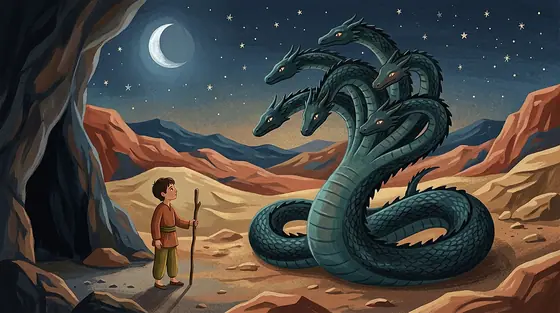
There was one, there was none. God’s servants were more numerous than mountain or stone. And to say too much of it was a great sin.1 In a certain country there lived a man, and he had one son and one daughter. They used to go to school, and in those parts there lived a seven-headed dev.2 Whatever girl pleased him, whatever girl he took a liking to, he would come and steal her and carry her off. When the girl came down with her friends to drink at the spring, the dev came and snatched her up and was gone. They searched mountain and stone, they went out of their minds, they could not find her. The boy went to school and came back again, and he would see his sister’s friends; but they would not tell him that the dev had carried her off. One day the boy came to blows with these girls. The girls said:
“Clear off, you filthy little thing! Is it us your strength is good for? The seven-headed dev took your sister — let us see your strength be good for him.”
The moment the boy heard it he came running home. “Mother, it is so and so. A seven-headed dev has carried off my sister. I shall go and find my sister and save her from the seven-headed dev,” he said.
His mother said, “Do not do it, my son; do not go, my son. The girl is gone and gone for good — the dev will eat you too, and he will not leave us a single one.” But they could not get the better of him.
The boy said, “You will make me provisions for a week, and nothing else; I am going to find my sister.”
So his mother laid him in a week’s provisions. The boy went and went, and came upon a forest. In the forest he lay down at the foot of a thornbush and slept. And as he slept they said to him in his dream: “This bush sprang up from the place where the blood of our Prophet was spilled.3 If you cut yourself a staff from this bush and take it in your hand, it will cut like a sword wherever you strike, and no strength will stand against yours.”
When the boy woke he cut himself a staff from the bush at once and took it in his hand. He went on his way. He went a little, he went far,4 and in the end he came to the top of a mountain. On the mountaintop there was a great house. Now, this house was the dev’s house. And there was his sister, sitting in the house all alone — the dev had gone out.
The girl said: “Oh, my brother, where have you come from, how did you come? If the dev comes now he will kill you. Quick, run from here, save yourself.”
The boy said: “No. I have come to save you. I am going to take you away with me. You show me where the dev lies down when he comes.”
The girl said, “There — he lies there at the foot of the chest.”
The boy got inside the chest and hid.
The girl said, “When the dev comes into the house he will catch your scent and find you.”
The boy said, “No — you cover me over.”
And then the dev came, rumbling and grumbling until the whole place shook, and called out, “Fatma!”5
The girl said, “What is it?”
The dev said, “There is a smell of the flesh of the sons of men.”6
The girl said, “Where would the son of man come from, to come here? Go on, pick the worm out from the root of your tooth — there will be a bit of a man left between your teeth.7 Who is going to come to the back of this mountain? Away with you, lie down in your place.”
The dev lay down and fell asleep. After a while he began to snore. And while he was snoring the boy came out of the chest, and no sooner had he struck the staff down on the dev’s head than he had cut it off and flung it aside.
The dev said, “Son of man, strike me once more!”
The boy said, “No. I was born of my mother once. I strike once; I do not strike twice.”8
He took his sister and they set out. Word of it ran everywhere at once: a brave lad had come and cut down the seven-headed dev, and had saved his sister and taken her away. As they were passing along the road they went into a forest, and they saw a strapping great fellow taking hold of oak trees by the root, tearing them up and flinging them aside. They went up to him. “Peace be upon you, friend,” said our boy.
The man said, “And upon you be peace.”
The boy asked, “Friend, what manner of strength is this? How is it that you tear up these oaks and fling them about? It was I who killed the seven-headed dev. Will you be my companion?”
The man said, “I will.”
The boy said, “Wait for me — I shall be back by Friday. I shall leave my sister and come and fetch you.”
They went on a little further. They looked, and what should they see: a brave fellow greasing great bars of iron and spinning them on one finger and flinging them away.9
The boy said, “Peace be upon you, friend.”
The big man said, “And upon you be peace.”
The boy said, “Friend, what manner of strength is this? How is it that you lift these great bars of iron and fling them about?”
The big man said, “Ah, friend, whatever I may be, I can never be as brave as the one who killed the seven-headed dev.”
The boy said, “It was I who killed the seven-headed dev. Will you be my companion?”
The big man said, “Of course I will.”
The boy said, “Then wait for me. I shall come on Friday.”
From there too they went on. They came and they came, until there was a man hooking great millstones on his little finger and spinning them round. “Peace be upon you, friend.”
“And upon you be peace.”
The boy said, “Friend, what manner of strength is this? How is it that you spin these millstones round and fling them about?”
The miller-man said, “Ah, friend, whatever I may be, I can never be as brave as the lad who killed the seven-headed dev.”
The boy said, “It was I who killed the seven-headed dev. Will you be my companion?”
The miller-man said, “I will.”
The boy said, “Very well, wait for me; I shall come looking for you on Friday.”
They left that place and came home. The boy said, “Mother, here — I have brought your daughter back. Make me another week’s provisions; I am going back again.”
His mother said, “Oh, my son, do not go. You have only just come; rest.” But the boy would not rest.
His mother made him a week’s provisions and the boy set out. He gathered up from along the road the one who flung the millstone, the one who spun the iron and the one who tore up the oaks, and the four of them became companions. On and on they went, and they lodged in the house of the dev he had killed.
The boy said, “Look, friends: every day one of us will keep the house. The other three will go hunting and get in our provisions.”
First the oak-tearer stayed in the house. The others went off and hunted. They hunted birds, and the oak-tearer cooked their food at home. He cooked pilaf, and roasted a partridge and laid it on top. He made up his companions’ beds and settled down to wait for them. He was stretched out on his bed, resting. The doors opened one after another, and rattle-rattle, a bare skull came in and said, “Give me a little pilaf.”10
The oak-tearer got up and gave it a plate of pilaf.
The Skull said, “I shall not be filled with this.”
And the oak-tearer, taking fright, said, “Eat it all.”
The skull sat down and ate the lot, and went out and away. When evening came his companions returned from the hunt.
“Friend, what have you done? Where is our food?”
The oak-tearer said, “I cooked it, but it is gone.”
They pressed him — what happened, how did it happen — but the oak-tearer would not tell. The next day the iron-flinger stayed at home. The others went hunting. The iron-flinger got up and cleaned out every corner and cranny. He plucked and washed the birds they had brought. And he cooked pilaf and roasted the meat and laid it on top. Again the skull came from somewhere over there and asked for pilaf, and this one too, out of fright, gave the skull the whole of the pilaf. When evening came and his companions arrived, they looked, and again there was no food. Though they pushed him to say what had happened, the iron-flinger would not tell. The next day they said, “Today you stay, you who spin the millstone.”
When morning came the others went out hunting. This one too got up, and when he had cleaned everywhere and cooked the food he made up the beds and stretched himself out on top of one. He said to himself, “The other two could not manage it, I suppose. Well — here is the food ready, and the beds too.”
And then he looked, and rattle-rattle the doors opened, and out of somewhere over there a bare skull came along.
“Give me a little pilaf,” it said.
The man got up at once and filled a plate with a little pilaf.
The Skull said, “I shall not be filled with this.”
The man, out of fright, said, “Take it, eat it all.”
The skull ate up all the food and made off. In the evening his companions came from the hunt, and again there was nothing to eat or drink.
“For heaven’s sake, friend, what is going on? Why will none of you say?” But all three of them knew, and out of fright they did not tell the boy.
“Tomorrow it will come upon you too, and you will see,” they said.
They lay down in their beds, and when morning came the three of them left the boy in the house and went hunting. The boy got up and cooked the pilaf, roasted the meat and laid it on top. He made up the beds, took his staff in his hand and hid behind the door. And then he looked — rattle-rattle, the doors opened. A bare skull came in at the door, and it had not got as far as saying “Give me a little pilaf” when the boy struck it with the stick, and the skull could barely fling itself out of doors. It ran and ran and went down into a well. The boy turned back from there and said, “You just stay there. Let us eat our bread, and then I shall know how to get you out of there.”
His companions came — and what should they see? The food ready, the beds ready.
The boy said, “Come, friends. Is a man afraid of a bare skull? Why did you not tell me? For three days you have left us hungry. Come, let us eat our food; it has gone down into a well over there, and I shall go and bring it out.”
They ate their food, and they took a rope in their hands and came to the mouth of the well. First they tied the rope round the oak-tearer’s waist and let him down the well. When they had let him down a little way he cried out, “I am burning!” and they pulled him up. Then they tied the rope round the iron-flinger’s waist and let him down, and when he too cried out, “I am burning!” they pulled him up; and they let down the one who spun the stones, and when he too cried out, “I am burning!” they pulled him up. Then this boy tied the rope round his own waist.
“Friends — as long as I say I am burning, let me down; as long as I say I am burning, let me further down. Whatever you do, do not pull me up,” he said.
They lowered the boy into the well. The boy reached the bottom of the well, and there in a corner lay a dev. He struck his stick on its head at once and cut off its skull and laid it aside. He walked on from there and went into a room, and there was a girl, the beauty of all the world, working at an embroidery frame. He opened four rooms, and in all four of them sat a beauty of all the world, each busy at some work. The man took them and brought them to the mouth of the well. First he tied the rope round the eldest girl’s waist and said:
“Pull her up. This one is the oak-tearer’s due.” They pulled her up. Then he tied the rope round the middle girl’s waist and said:
“Pull — this one is the iron-flinger’s due.” And after that he tied the rope round the third girl’s waist and said:
“Pull her up. This one is the stone-spinner’s due.” And he sent her up. And the youngest he kept for himself. The little one was lovelier than any of them.
The girl said, “Look, my brave one: you come up first. If you send me up they will not pull you up; you will be left in the well.”
The boy said, “No. You will go up first.”
He tied the rope round this girl’s waist and sent her up. They pulled the girl and got her out of the well. As the girl was coming out of the well she said, “Look, my brave one, since you will not come up first” — and she tore two hairs from her head — “take these hairs. If they do not bring you up, strike these two hairs one against the other. Two rams will come, one black and one white. Whatever you do, do not mount the black ram. If you mount him he will carry you seven layers beneath the earth.11 Spring onto the white ram and mount him; he will bring you out onto the face of the earth.”
The boy took the hairs and put them in his breast. When the girl got up to the top they said, “Look at him — he has kept the loveliest for himself. Let us leave him to stay in the well; let us take the girls and go.”
They dropped the rope down and took the girls and went. When the boy understood that they had gone, he took out at once from his breast the hairs the girl had given him and rubbed them one against the other; and he looked, and two rams, one black and one white, came butting and striking at each other. And the boy, meaning to put his foot on the black and mount the white, put his foot by mistake on the white and mounted the black.12 Down he went, seven layers further still to the floor of the earth; and when he came down, in a dark room seven layers under the earth there sat an old granny. He went up to her and said, “Granny, I am thirsty; give me a bowl of water to drink.”
The granny said, “Alas, my child — a dragon lies in the way of our water, and every day we give it a victim. It takes as long as the dragon needs to eat it, and in that time we fill our water. My water had run out; I cannot give you any. And today the turn has come to the padishah’s daughter. We shall fill our water in the time the dragon takes to eat her,” she said.
Is that so? It is. He took his staff in his hand at once and came to the fountain. On the near side of the fountain there was a plane tree. The boy came and slept under the plane tree. When sleep had barely reached his breast he woke at a roaring and a clattering. He looked, and a dragon was climbing the tree. And at the top of the tree, were there not nestlings? They were shrilling and shrieking, over and over. Now, these nestlings were the nestlings of the Zümrüdü Anka bird.13 Every year this dragon came and ate the young. No sooner had the boy struck his staff than he had brought the dragon down out of the tree. He killed it and saved the nestlings. He lay down at the foot of the tree again and slept. And the padishah’s daughter had come, and was waiting her turn. When she saw that the boy had killed the dragon she dipped her hand in the blood at once and struck it on the boy’s back.14 She made her way back and came to her father’s house. Criers were called at once: “A brave lad has come and killed the dragon. Our water is saved. Do not say you have not heard!”15
As the boy lay sleeping there, the Zümrüdü Anka bird came, and just as she was about to kill the boy the nestlings shrilled from the nest, “Oh mother, he saved our lives!”
The bird found speech and said, “O son of man, you are not of this world. You have killed the dragon. You have saved my young, and the padishah’s daughter too. For seventy years this dragon has eaten my young. I have never reared one and seen it fly from the nest. For this kindness of yours I shall bring you out onto the face of the earth. Only — the padishah will call you into his presence and ask you your wish. Say forty batmans of meat and forty skins of water.16 Ask for nothing else. Bring the meat and the water, and I shall carry you.”
The boy got up from there and came to the old woman’s house. Meanwhile the padishah’s men had summoned everyone at once: all the men were to pass before the palace, so that whoever had killed the dragon should be brought to light and the padishah should reward him. They came and passed, they came and passed. This one said, “I killed it”; that one said, “I killed it.” The padishah’s daughter looked them all over, and the boy was nowhere to be seen.
“There is not a man left in the village — only, a young fellow is lodging in the house of that blind old woman.17 Let us see him as well,” they said.
The men went and fetched the boy. The moment the padishah’s daughter saw him she knew him, and she saw the mark of her fingers on his back too.
The padishah said, “My son, you have killed the dragon. You have saved my daughter. Say what your wish is.”
When the boy said, “I wish you your health,”18 the padishah said, “No, my son — no good comes to you from my health. Wish your wish.”
The boy said, “I want forty batmans of meat and forty skins of water.”
The padishah said, “You have asked a hard thing; but you saved my daughter. I too shall grant you your wish,” he said.
He gave his men the order at once, and they made ready forty batmans of meat and forty skins of water and carried them to the place the boy wanted and handed them over. The boy hung the meat on one of the bird’s wings and the water on the other, and mounted on top himself.
The bird said, “As often as I say lak, give me meat; as often as I say luk, give me water.19 I shall take you up and carry you.”
As often as the bird said lak he gave meat, as often as it said luk he gave water. The bird flew and flew and drew near the face of the earth. And just at that moment the meat ran out. Thinking, “Oh, the bird will not get me out,” he cut a piece of meat from his own leg at once and put it into the bird’s mouth. The bird, knowing it by the taste of the meat, hid that piece under its tongue and brought the boy out onto the face of the earth.20
The bird said, “Come now, son of man, walk, and let me see you.”
The boy said, “No; you fly, and I shall walk.”
The bird said, “No — walk, and let me see.”
When the boy walked he was limping a little, and blood was running from his leg.
The bird said, “Come here, son of man; come to me.”
It took out at once the meat it had hidden under its tongue and laid it on the boy’s leg. When it passed its tongue over it the boy was as he had been on the day his mother bore him. They took their leave of one another. The bird flew away.
The boy came, and what should he find: his companions were holding a wedding for these girls. And someone was wanting to take the girl the boy had kept for himself. He showed the girl the hairs of her own head, so that she should make a game of jereed a condition of the wedding21 — “and I shall come,” he said. The girl sent word to the man who was to marry her: “Let him come out to the jereed.” And this boy mounted a horse at once and came out into the field. When he struck his staff he brought the bridegroom down off his horse. He went and they threw their arms about each other, the girl and he.
They attained their heart’s desire; may we attain ours too.22
Translator’s Notes
1. The tale opens with a rhyming formula: Bir varmış, bir yokmuş. Allah’ın kulu dağdan taştan çokmuş. Çok söylemesi gayet günahmış — “there was one, there was none; God’s servants were more numerous than mountain and stone; to say much of it was a great sin.” It is a sound-shape rather than a statement, and its work is to tell the listener that the story has left ordinary time. The sense is kept here and the rhyme lost. Compare the openings of the other Anatolian tales in this archive, which use the same formula in slightly different words. ↩
2. The title calls the creature a ejderha, a dragon; the tale itself calls it a yedi başlı dev, a “seven-headed dev,” throughout, and keeps a separate, genuine dragon for the underworld episode later on. The two are not the same creature in the text. A dev is the ogre of Turkish and Persian tale — man-shaped, enormous, living apart from people, often asleep in a cave or a house on a mountain, and in the habit of carrying off girls. “Giant” is the closest single English word but carries the wrong associations, so dev has been left as it stands. The title has been translated as it is given in the source. ↩
3. Peygamber efendimizin buraya dökülen kanı — “the blood of our Prophet, spilled here.” The staff cut from a bush grown on holy blood, which thereafter “cuts like a sword,” is a folk-Islamic motif: the hero’s weapon is not forged but given, and its power is inherited from a sacred wound rather than from the smith. The source does not say which prophet or which wounding is meant, and nothing has been supplied here. ↩
4. Az gitmiş uz gitmiş — “he went a little, he went far,” another rhyming formula, used to pass over travel that does not need describing. In Turkish the pair of words rhyme and mean almost nothing apart; the rhyme is lost in English. ↩
5. Fatma is the sister’s name, and it is the only name anyone in the tale is given — the hero is “the boy” from first page to last, the companions are named by what they can lift, and the maidens are “the beauty of all the world.” The dev, oddly, is the one who names her. ↩
6. İnsanoğlu eti kokuyor — “it smells of the flesh of the son of man.” İnsanoğlu, “son of man,” is the standing word for a human being in the mouths of devs, giants and birds in Turkish tales; it is used again later by the Zümrüdü Anka. The smelling-out formula is the same one English knows from “Fee-fi-fo-fum,” and the hiding-and-being-smelled scene that follows is its standard setting. ↩
7. Git şurada dişinin dibini kurtla — literally “go and worm out the root of your tooth.” The sister explains away the smell of her hidden brother by telling the dev that what he smells is a scrap of his last human meal still stuck in his teeth. The verb is an everyday word for picking out grubs or maggots, and the insult in it is deliberate. ↩
8. Ben anamdan bir doğdum. Bir kere vururum bir daha vurmam — “I was born of my mother once; I strike once, I do not strike twice.” This is a motif, not a boast: a dev, giant or dragon struck a second time is restored by the second blow, and the monster’s request for one more stroke is a trap. The hero’s refusal is the correct ritual answer, and tales across Anatolia give it in almost these words. ↩
9. The three companions are named only by their feats: meşe söken, “the oak-tearer”; demir atan or demir köteleyen, “the iron-flinger”; and değirmen taşı köteleyen, “the one who spins the millstone.” The verb kötelemek is regional and is not in standard Turkish; from the two contexts here — great bars of iron greased and kötelenip flung from one finger, and millstones hooked on a little finger and kötelenip thrown — it has been read as whirling or spinning a heavy thing round before letting it go, and translated accordingly. [Verification needed] on the precise regional sense. Companions of superhuman strength, met on the road and gathered one by one, are a fixed opening of this tale-type (see the closing note on the tale as a whole). ↩
10. Kuru kafa — literally “dry head,” the ordinary Turkish word for a skull. Here it is a walking skull that opens locked doors, demands the cooked food and eats all of it, and terrifies each strong man in turn into silence out of shame. In the tale’s economy it exists to sort the hero from his companions: all four are brave, but only one is not ashamed to admit to having been frightened, and only one thinks to wait behind the door with a stick. ↩
11. Yedi kat yerin altı — “seven layers beneath the earth,” the lower half of the layered cosmos of Turkish tradition, matched by seven heavens above. The hero is already at the bottom of a well in a world below his own when the rams are offered to him; the black ram takes him seven layers further down again, which is where the dragon, the thirsty village and the Zümrüdü Anka are to be found. ↩
12. The mix-up is in the original and is the hinge of the second half: told to tread on the black and mount the white, the boy treads on the white and mounts the black. Nothing is made of it — no explanation, no reproach — and the tale simply follows him down. ↩
13. Zümrüdü Anka — the great bird of Turkish tradition, the Anka or Simurgh, who nests in a tree whose young are eaten each year by a serpent or dragon, and who carries the hero who saves them up out of the world below. She is not the phoenix, and the name has been left untranslated; the archive holds another tale of hers from Kastamonu. ↩
14. The bloody handprint pressed on the sleeping hero’s back is a recognition token: the rescuer sleeps through his own reward, impostors come forward in his place, and the mark on his body settles the matter when he is finally found. The same device turns up across the tradition, usually as a ring, a scarf or a piece torn from a garment. ↩
15. Duyduk duymadık demeyin — “do not say we heard it and did not hear it,” that is, nobody may claim afterwards not to have been told. It is the standing closing phrase of a town crier’s proclamation and is still used in Turkish for a public announcement. ↩
16. A batman is an old Anatolian weight with no single fixed value, somewhere in the region of several kilos up to a dozen or more depending on place and period; forty batmans is “as much as a bird that size would need,” not a measured quantity. A tulum is a whole animal hide sewn up and used as a container for water, yoghurt or oil. ↩
17. The old woman who gives the hero shelter is introduced simply as yaşlı bir nine, an old granny, and only here — in the mouths of the padishah’s men — is she called blind. The source is inconsistent on the point; nothing has been added or removed. ↩
18. Sağlığını dilerim, “I wish you your health,” is a formal refusal of a reward: the correct answer of a well-brought-up petitioner, which the giver is then expected to overrule. The padishah’s reply to the real request, Güç buyurdun — “you have ordered a hard thing” — is the matching formula from the other side. ↩
19. Lak and luk are the bird’s two calls, meaning nothing except meat and water. They are kept as they stand; the pair works by its sound, and any English words put in their place would turn a noise into a command. Feeding the bird to the beat of its own calls during the flight is part of the motif, not an invention of this telling. ↩
20. The hero cutting flesh from his own thigh when the meat runs out, and the bird keeping the piece under its tongue and healing him with it once they land, is one of the fixed endings of the Zümrüdü Anka’s flight. The bird’s “knowing it by the taste” is the whole point: the debt is settled in both directions. ↩
21. Cirit (jereed) is the mounted javelin game of Anatolia and Central Asia, played by two teams of riders throwing blunt wooden javelins at one another. A game of jereed as a condition of a wedding gives the disguised or absent hero a lawful way back in: he need only ride out and unhorse the bridegroom in front of everyone. ↩
22. The closing formula Onlar ermiş muradına, biz de erelim muradımıza — “they attained their heart’s desire; may we attain ours too.” It hands the listener back to ordinary life. ↩
On the tale as a whole. Offered by the translator and not taken from the source: the second half follows the international tale-type usually catalogued as ATU 301, “The Three Stolen Princesses” — superhuman companions gathered on the road, a descent into a world below, maidens freed one by one and hauled up, the companions cutting the rope and taking the credit, and a great bird carrying the abandoned hero home. The thesis from which this text is taken is itself a study of the motifs and types of the Yozgat tales and will give its own classification; this archive has not seen that page, so no type has been entered in the record for this tale.
On the register. The Turkish is colloquial throughout rather than dialectal — the frame verbs are the oral -mış past that marks reported, unwitnessed narration from beginning to end, and the diction keeps regional and spoken forms (şordan for “from over there,” dellal for the crier, ulan as an abusive vocative, köteleyip in note 9). English has no equivalent of the -mış past and nothing has been substituted for it; the register has been kept plain and spoken rather than reproduced as an invented English dialect.