The Weeping Pomegranate and the Laughing Quince — An Anatolian Folk Tale
ℹ️ This is an English translation of a Turkish oral folk tale. The regional dialect of the source text could not be fully preserved in translation. Read the Turkish original here.
“The Weeping Pomegranate and the Laughing Quince” is an Anatolian tale from the Billur Köşk Masalları collection prepared by Tahir Alangu. It begins with a padishah who has nine daughters and no son, and who fears for the end of his line.
ℹ️ This is an English translation of a Turkish oral folk tale. Read the Turkish original here: AĞLIYAN NAR İLE GÜLEN AYVA.
THE WEEPING POMEGRANATE AND THE LAUGHING QUINCE
There was one, there was none; God’s servants were many. To say “many,” to say “none” — both were a sin.1 In times long past there was a padishah who had nine daughters. One day, sitting with his wife the sultana, he fell into deep thought and suddenly began to speak:
“I have nine daughters. Strangers will take them and they will marry, and in the end the two of us will be left alone. If I die there is no son of mine to sit upon my throne. Our root will wither, crown and throne will pass out of our hands, my hearth will go cold. For thinking of tomorrow, sleep will not come to my eyes; I have lost all taste for the world. If you bear me a girl this time as well, I shall hand you to the executioner, and the child with you.”
So he said, and rose, and went. The poor sultana was heavy with child, her belly at her nose. She listened to the padishah’s words, bitter as poison, and could not open her mouth to say so much as one word; she grieved herself grape-small and wasted herself thread-thin, holding the fault to be her own. She rose and withdrew to her apartments, and wept night and day over her black fortune.
Happy or sorrowing, time passes quickly in tales. After a while her hour came, and in her fear she could tell no one. She withdrew to a remote little corner of the palace where nobody set foot, took with her the dowry maidservants she had brought from her father’s house and the men whose work and word she could trust, and quietly made ready for the birth so that no one should sense it. At midnight the pains came close together, her eyes shone, and she brought her tenth daughter into the world. At once the midwife and the sultana wrapped and swaddled the child before its father could come and see it, and only when morning came did they send word to the padishah that a son had been born. The padishah came into the room out of breath, all but choking with joy, and those who were there said with one voice, “May it be auspicious, let the name be yours to give and the lifetime God’s to give — you have a son, my padishah!” and laid the swaddled child in its father’s arms. The padishah’s feet tangled under him, he shed tears of joy, and beginning with those in the room he distributed gifts and bounties to the whole household of the palace. He had a hundred and one cannon fired and sent out criers; he sent messengers and post-couriers to distant towns and neighbouring lands to carry the happy news. He had tables set up in the public squares, fed the poor for forty days, clothed those with nothing on their backs, and made no distinction between townsman and stranger: to everyone who came and went they scattered bright gold coins. For the guests and envoys who came from all four quarters with presents, tents were pitched and festivities and processions arranged. For forty days and forty nights the whole country laid its work aside, made a wedding feast of it, and made merry.
Time came and time went, and the child grew. The poor queen mother and her people did not let the child out of their sight by day or by night. They cut its hair as it grew, dressed it in boys’ clothes and gave it a boy’s upbringing. The child learned to handle weapons, to ride, to wrestle with those of its own age — and so came to be about twelve years old, when the time came for the circumcision.2 The queen mother fell into deep distress; every day she waited in a flutter of dread, thinking, “Now our secret will spill out,” and withdrew to empty rooms to weep. One day the child came to its mother and, seeing her weeping, could not bear it:
“Oh mother dear, what has happened, that you withdraw to lonely corners and weep so often?”
And when she was asked, the mother said:
“Ah my child, if I do not weep, who is there to weep? When you were born we told your father you were a boy, and to this day we have let nothing be suspected. The padishah your father still believes you a boy; he wants to see you come of age, to have you circumcised. He will find out that you are a girl, and he will hand us both to the executioner. That is why I weep.”
At that the child thought for a while, and then said to her mother:
“Do not grieve at all, mother dear, and do not weep. You did well to tell me this. I shall go now to my father the padishah and beg him.3
“I shall say I am too young in years; surely he will not have me circumcised this year.”
So she said, and rose, and went straight to her father, and kissed his hand and pressed it to her face, and began to weep. When the padishah saw his only son weeping he was much troubled:
“My one and only son, my dear prince, why do you weep?”
And when she was asked, she said:
“Oh father dear, I have heard that you mean to have me circumcised, and that is why I weep. I am still small.”
At that the padishah considered that the boy spoke truly, that there was still time, and that he should not be distressed:
“My son, my child, do not weep; let it stand over for this year — next year, God willing, the thing will be done.” And he stroked his back. And the child joyfully kissed her father’s hand and came running to her mother and threw her arms about her neck:
“Oh mother dear, I have won my father’s heart. He has left it to next year. Dry your tears now.”
At that the poor woman’s face laughed a little, and her heart opened, and she embraced her child and kissed her eyes.
Time passes quickly in tales; days and months fly one after another. A year goes by like a day. When the time for the circumcision came round again, the poor mother withdrew to a lonely room and wept inwardly. One day the child sought her mother in this corner and that, and at last found her in this lonely room, and came to her, and seeing her weep could not bear it:
“Oh mother dear, what has happened, that you withdraw to lonely corners and weep to yourself?”
And when she was asked, her mother said:
“Ah my sultana daughter, if I do not weep, who is there to weep? The respite your father gave last year has run out. Preparations are being made for the circumcision feast. Then it will come out that you are a girl — what shall I do, what shall I make of it? I am at my wits’ end.”
At that the girl said:
“Do not grieve at all, mother dear. I shall go now to my father the padishah and beg him. I shall say I am too young in years. He will pity me and surely not have me circumcised this year either.”
So she said, and rose, and went straight to her father, and kissed his hand and pressed it to her face, and began to weep from the heart. He was a padishah; when he saw his only son weeping he was much troubled:
“My one and only son, my dear prince, why do you weep?” And when she was asked, she said:
“Oh father dear, I have heard that you mean to have me circumcised, and that is why I weep. I am still small.”
At that the padishah considered that the boy was indeed small, that there was still time, and that he should not be distressed:
“My son, my child, do not weep; let it stand over for this year — next year, God willing, the thing will be done.”
And he stroked his back. And the child joyfully kissed her father’s hand and came running to her mother and threw her arms about her neck:
“Oh mother dear, I have won my father’s heart. He has left it to next year. Dry your tears now.”
At that the poor woman’s face laughed a little, and her heart opened, and she embraced her child and kissed her eyes.
Time passes quickly in tales; days and months fly one after another. A year goes by like a day. The time for the prince’s circumcision came round again. The preparations had gone forward. Again the poor queen mother shut herself in lonely rooms and began to weep inwardly. And the child, searching for her mother here and there, at last found her in a lonely room; and seeing her weeping and beating her breast, and knowing the reason, could not bear it either, and began to weep. The mother, for her part, clasped her child:
“Ah my sultana daughter, by whatever means we managed it we put your father off two years more. But now you have grown well up, and we cannot invent a pretext and have this thing deferred. Before long everything will come out. There is no escape from it. In the end your father will hand us both to the executioner. Tomorrow is the last day of our lives.”
At that the girl too could bear no more:
“Oh my dear mother, do not weep and distress yourself so. Tomorrow, if my father summons me to be circumcised, I shall go and ask his leave for half an hour to ride. Then I shall go to the royal stable and mount a swift horse, and from there I shall flee and be gone. Do not weep after me, whatever you do. I shall move to other countries, and shelter there, and live. Let us see whether God will turn our end to good. There is no other remedy.”
So she said; and they thought and turned it over, and together settled upon this decision.
When morning came, the great square before the palace was enclosed, and along one side coloured tents of state were pitched and the whole circuit hung with festival banners. On one side the cooking cauldrons, the sweet and the savoury, were set upon the fires to boil, while on the other the preparations for all manner of races and entertainments were begun. The people of the written plain and the open country, of the mountain and the flatland, of village and of city, began to gather at the feast-ground in companies, some mounted and some afoot, talking and sporting as they came. Those summoned by messenger from the remotest corners of the realm, and the honoured guests to whom word had been carried by courier from the neighbouring foreign lands, were each lodged in their separate tents and entertained. Masters of every craft, dancing-girls, musicians, Romani bear-leaders, conjurors, tumblers and acrobats came in troop after troop; and the tribe of beggars, reckoning that in such a tumult alms would not be spared, came running from all four quarters and swarmed into the square. The marshals and the staff-men whirled about in the middle of it all, trying to show this crowd to its places and bring it into order.
Saying it was the day of his son’s coming of age, the padishah dressed in green, and had robes of honour put upon the great men of the state according to their degree, and distributed bounties.
At last the preparations were finished, and word was sent for the prince to come as well. The prince gave no sign of what was within, and came into her father’s presence, and first kissed his hand and then stood before him with her hands clasped.4 Her father’s mouth was in his ears for joy:
“My son, my prince, you have now entered your full fourteenth year; you have set foot in young manhood. To delay further in this matter would be a shame, and would breed gossip, and in the end would surely bring trouble. Everything is ready, the guests have come, and a great assembly has gathered. There is no saying no — today you will certainly be circumcised. Come along, my brave prince.”
And at that the child said:
“Very well, it is fitting, father dear; your command upon my head. Only give me leave for half an hour, that I may ride once round this square. After I am circumcised I shall not be able to mount a horse for some months, and besides I should like to see the people who have come to the feast a little more closely. After that let them circumcise me.”
At that her father took this kindly:
“Very well, that will be a fine thing, my prince; go, ride round and come back.”
And he gave the prince leave for half an hour. And she ran straight to the royal stables and went along the stalls, looking for a suitable and really swift horse. In a dark corner of the last stall she saw a raven-dark horse tethered: mane and tail black, without mark or speckle, without one white hair upon him.5 She liked the look of the beast and came up to him, and stroked his head, his neck, his mane and his back — and began to weep. The horse listened to this child, and listened, and understanding how matters stood, found speech:
“O my sultana, why do you weep so?”
The girl was startled and could not tell what had happened; she looked about her and could see no one. Then the beast said again:
“O my lady sultana, why do you weep so?”
And at that she understood that it was the horse that had spoken to her:
“Ah my crow-black, my dark one, if I do not weep, who is there to weep? Since the day I was born my father has believed me a boy. For two years he has wanted to have me circumcised. When it comes out that I am a girl he will surely hand my mother and me both to the executioner — if I do not weep, who is there to weep? I have no remedy left but to mount a horse and flee this country. I have taken leave of my father for half an hour, to mount a horse and ride once round the square. My purpose is to find a way and escape. So this is how it stands and so the matter lies — what am I to do, my dark one? Say something.”
At that the horse, having heard all this, said:
“Ah my fine young sultana, do not trouble yourself at all. With God’s leave I shall take you, and before they have gathered their wits we shall be out of sight; we shall move off to other countries and be gone. But my charge to you is this: draw my girth tight under the saddle; when you are mounted upon me take firm hold of my rein and grip hard with your legs; and when I break into a full gallop and draw myself out from head to tail like a sapling, cling close about my neck — for I go like the blowing wind. If they fire after me they will not come up with me.”
So he said. The girl did as the horse told her, first kissed his eyes and then sprang upon him, and rode out into the square and galloped him from one end to the other. The people and the soldiers gathered there were much pleased by the prince’s bearing, and applauded. When the half-hour had passed, the prince suddenly bent to the horse’s ear and called, “On, my dark one, light of my eyes!” — and the horse cut through the ring of soldiers and people as a knife cuts, slipped away like the blowing wind, and in the blink of an eye was gone.
Those who were there understood after a while what had happened, and a confusion broke out. They ran and gave the news to his father; “Alas, the black horse has taken the prince and carried him off!”6 — and a shouting filled every quarter. Horsemen went after him, and scattered to all four quarters searching here and there, hill and valley, but could not find the least trace of him on road or pass. You would have thought the dark horse’s hooves had never touched the ground. Crumpled with weariness and sorrow, unable to hold hand or foot still, they came back and gave the news to the padishah. The people gathered for the feast, the padishah, the court, townsman and stranger alike, beat their breasts and wept together for the prince. The dancing-girls stopped, the music fell silent. The drums no longer boomed, the marshals no longer called. No one laid a hand on the cooked food. They put out the fires and overturned the cauldrons. Evening came, and the feast broke up and scattered.
Let us come to the counterfeit prince and the dark horse. The dark horse, once he had taken her up, carried her six months’ journey in a single day, and at last stood steaming and snorting in a lather of foam. He found speech:
“There, my sultana — at least I have saved you. From here you may go where you will. The world is full of wicked folk; look to yourself.”
At that the girl got down from the horse and threw her arms about his neck, and began to weep with both eyes like two fountains:
“O my own horse, my soul’s companion — first God, and then you. Now I go from here; I go, but if some calamity comes upon me in these wild places, what shall I do?”
At that the horse said:
“O my sultana, let me give you three hairs from my mane; keep them in your bosom. When something befalls you, take these hairs out and strike them one against another, and I shall be there at once.”
At that the lady sultana rejoiced greatly, plucked three hairs from the horse’s mane and put them in her breast. She threw her arms about the dark one’s neck and kissed both his eyes. In an instant the horse vanished in the middle of a cloud of smoke and was gone; and the girl set out from there and fell into the dust of the roads of exile, and walked on.
Going and going, this girl’s road brought her to a town, and before her rose a great palace. Next to it was an enormous kitchen. Smoke came from its chimney and smells poured from its door. The hour was evening. At once she opened the bundle she had brought with her, changed out of her gold-embroidered clothes, and put on the dress of a traveller come from far away. Then she went up to the door of the palace kitchen and looked in — and saw the cooks bathed in sweat. They ran from this hearth to that one, from cauldron to pan; and over on the other side the apprentices were smashing the bottoms out of their mortars with a thud, thud, swinging their pestles at the great stone mortars facing one another and calling “Hay Hak, hay hak!” as they pounded keşkek.7 The maidservants’ eyes were red with picking the stones out of the rice; the serving-lads, their eyes full of tears, were chopping onions. In that huge kitchen there were forty fires on forty hearths, and on every one of them a different dish boiling. The girl went in, and went up to the man she judged to be the head cook: one who dealt out orders this way and that, who darted here and there with a ladle in his hand and tasted from every cauldron; shaven-headed, flustered in every movement, a wind at the back of his neck and a frog’s bend in his waist, who sat down with a “very well, very well” and got up with an “alas, alas,” and whom no one could look at without fear. At once:
“Head cook, chief of cooks, I see your work and your haste are great — will you take me on as an apprentice?”
And when he was asked this, he darted about and shouted and bawled and shoved the girl aside, one eye on the food and one on the work:
“Can’t you see the fires are burning over our heads and the cauldrons boiling? Mind you don’t mix salt into the sweet and sugar into the meat! Don’t let the halva catch, don’t let the bottom of the stuffed-vegetable pan burn, you idlers. Draw the fire from under the liver wrap, throw a stick of wood under the boiled meat. Out from under my feet, you witless traveller — can’t you see how pressed we are?”
So he went round shouting. And the girl, making as though she had not heard, at once took an apron from somewhere there and put it on. She went in among the clumsy scullions. In no time at all she had come to every hearth like Hızır,8 one hand in the sweet and the other in the salt, supplying what every one of them lacked, finding this and fetching that and making all complete. One after another she began to lift the pans and cauldrons from the fire, saying, “This is done, this one is cooked too, it is ready.” When the head cook suddenly saw that order had come over the place he rejoiced, and clapped the girl on the back:
“I have made you chief scullion, master cook. May your hands never ache, may plenty brim over from your ladle.”
So he said, raising both his hands in blessing. And the girl said in her turn:
“Now, head cook, see, everything has come into order. Sit down in that corner and tell me: what is the reason for all this anxious preparation? For whom is so much food being cooked?”
At that the head cook drew a long breath:
“Ah my boy, that is the bitter part of it; I wish you had not asked, and that I had not had to tell. Once in six years a giant9 comes to this country by night, eats our padishah’s liver, and goes off again. Tomorrow night is the time for this giant to come. That is the reason for our haste — we are preparing the funeral meal.”
When our Sultan in Disguise heard this she bit her finger in fear, and was dumbfounded. That night she too, with the cooks and the scullions, did not sleep at all; until morning they busied themselves with cooking.
When morning came, the Sultan in Disguise went into the palace, climbed straight to the upper floors, and began to walk about. As she went she came to a room and saw a lady sultana seated in a corner, dressed in black from head to foot. From there she went to another room and saw that the room was in black from top to bottom; even the furnishings were covered with black cloths. From there she came upon another room, and saw in the middle of it a divan, and in it a sultana in scarlet from head to foot.10 From there, turning and wandering, she came to the room where the padishah was, and saw that they had held smelling-salts to the poor man’s nose; physicians and hodjas were gathered about his head, and he lay stretched out, senseless. The hour drew on to evening and the giant’s coming was near. All the people of the palace had huddled fearfully into corners and nooks and waited for the giant to come. Suddenly this girl remembered the hairs the horse had given her; she drew them from her breast and struck them one against another, and that instant the dark horse came out of a cloud of smoke and halted before her:
“Command me, my sultana!”
So he said, and pawed the ground. And the girl at once stepped up and kissed both the horse’s eyes:
“Oh my dark one, I ask of you a naked sword such that when I strike this monstrous giant once with it, it will cut him in two through the middle.”
At that the horse pawed the earth and shook his head:
“Take it, my sultana — a sword better than the one you asked for. Do not strike twice where you have struck once.”
So he said, and put a naked sword into the girl’s hand, and vanished in a cloud of smoke, and was gone. And from there this girl took the sword and came straight to the room where the padishah lay, and slipped quietly inside and hid in a corner. In the middle of the night a rushing and a roaring was heard out of the sky, and all at once the place went pitch dark. While eye could not see eye, after a time there came a sound of thump, thump, and a monstrous giant dropped into the middle of the room. The Sultan in Disguise, waiting ready in her corner, sprang out, cried “O God, help!” and brought the sword in her hand down on the giant’s neck in such a stroke that his head left his body at once and rolled over several times. At that moment a voice came from the giant’s head:
“O brave one, let me know you are a man indeed — strike me once again!”
But though it said so, the girl remembered the dark horse’s charge, and made no sound, nor struck a second time. The monstrous giant’s life went fully out of him, and he toppled there and lay.
The girl at once cut off one of the giant’s ears and put it in her pocket. She walked away and went. She came back to the kitchen, put on her apron, took up her ladle, and set to work.
Morning came, and the padishah, half spent and half senseless with fear, came out of his swoon and opened his eyes, and felt himself over to find that he had not yet died. Then he looked into the middle of the room and saw a coal-black monstrous giant lying there with his head cut from his body; the wits of those who saw it left them. He fell into deep thought, wondering, “Who can it be that has killed this giant?” — but could make nothing of it. From the beginning of time, when this giant came, no brave man of this country had ever stood out against him; not a word about such a thing is written even in the history books. He could make no sense of the matter, but rejoiced beyond measure and gave thanks to God. And when he rose from his place and walked outside, he saw the people of the palace waiting at the foot of the doors with coffin and shroud and coverings. As in years before, they had made ready the things needed for a funeral and sent word to the corpse-washers and the imam, and had been waiting there trembling since midnight. When they saw the padishah walking about alive and well, and in good spirits too, laughing and talking, they were struck dumb. All of them offered prayers — “May it pass from you, may God give you long life!” — and cast off the weight from their hearts. The padishah stopped there and said to them:
“Which of you is it that killed the monstrous giant inside, the one whose head is off his body?”
And when he asked this, they looked in at the door and saw everything; and several of them came forward and said without blinking:
“We killed it, my sultan.”
So they said, and stood their ground. And though the padishah’s heart did not warm to these words at all, he bestowed gold and farms upon them in plenty. All the people of the palace came running in file, down to the maidservants and the kitchen boys, and each got a share for themselves. At one point the head cook said to this Sultan in Disguise:
“Why are you standing there, my boy? The padishah has escaped a death there is no turning back from, and is handing out bright gold to everyone. Go and get yours too!”
But even when he said so, the Sultan in Disguise said:
“If I go before the padishah he will drive me out at once.”
And though she hung back, those in the kitchen said with one voice:
“The padishah is in joy; he has escaped death. He is giving out the alms of his head and his eyes, scattering treasure. He turns no one from his door, not the meanest. The time is now; he will surely not grudge you your present either.”
And when they had said this, the girl rose and went straight before the padishah. Nine times she kissed the ground and straightened, and stood with her hands clasped:
“O my padishah, it was I who killed this monstrous giant last night towards morning.”
But though she said so, the padishah did not believe it:
“You bald scullion,11 what is your bulk, that you could kill this monstrous giant?”
At that the Sultan in Disguise took the ear of the giant she had killed out of her pocket:
“If you will not believe my words, take this ear, go and have a look at the giant’s head.”
So saying, she held it out to the padishah. The padishah took it and saw that it was a strange, bloody piece of flesh resembling neither a human ear nor an animal’s. He rose at once and went to the giant, and there in one of the places where an ear should be was a bloody hole. They set the piece of flesh against it, and it fitted exactly. They understood that the kitchen boy’s words were true. The padishah said:
“O my son, my brave son — ask of me, what will you have?”
And when he said so, the Sultan in Disguise did not break the bounds of good manners:
“I wish only your health, my padishah.”
So she said, and looked down before her. The padishah asked again, and again she said:
“I wish only your health, my padishah.”
So she said, and again looked down. The subject’s custom is to pray, the sovereign’s custom is to bestow: the padishah must ask once more.12 And when he asked the third time:
“I pray for your health — but my padishah, in one of those rooms there sits a lady sultana dressed in scarlet, drawing herself up and sitting at her ease. It is she I would ask of you.”
At that the padishah stopped short:
“My son, how many handsome young men have been suitors to that girl, have sent match-makers, have come themselves, have dispatched go-betweens great and small! Even the young men I liked and approved we could not make her approve. What do you want with that scheming, stone-hearted dealer in coquetry? In the other rooms I have my black-clad, white-hearted, pure, rose-and-white, delicate daughters; choose which you please and I shall give her to you with her gold thread and her spangles and a dowry worth a treasury. I shall make such a wedding that it will be famed through seven climes and four corners.”
But though he said so, the Sultan in Disguise stood her ground, hands clasped, eyes on the floor:
“My padishah, my mad heart has fallen upon her. If you will give her, you give this girl out of your bounty; if you will not, long life to you — I want no other.”
So she said, and stood planted there. The padishah saw that the boy was in no state to hear reason. At once he gave an order. He had his Scarlet-Clad daughter summoned; and she came, and stood before the padishah with her hands clasped. The padishah said:
“O my Scarlet-Clad sultana daughter, this brave young man asks for you; he has won me my life, he has killed the monstrous giant. Up to this day you have turned many a brave man from your door; surely you will not say no to this one. I have given you in marriage, and there’s an end.”
But though he cut it short like this, the girl spoke up:
“Oh my padishah father, give me one night’s leave; let me lie down to an istihare,13 and whatever I see in my dream I shall tell you tomorrow.”
So she said, and when the padishah gave her leave she rose from there and came straight to her room.
Night came and the place grew still; and when even the serving-lads and the maidservants had curled up in their corners, and the watchmen at the outer gates and on the towers were calling to one another and crying “God is one, one!”14 as they went their rounds, the Sultan in Disguise slipped quietly along and came to the Scarlet-Clad Sultana’s door, and listened and watched through the keyhole. She saw that this girl was going busily here and there about the room, making something ready. At last she set a golden basin in the middle of the room and poured water into it from a silver ewer. Just then a dove came in at the window with a whirr of wings. It went into the basin, fluttered twice, and when the water had run off it, shook itself free of the dove’s shape and came out in the shape of a young man as handsome as a piece of the moon. He and the Scarlet-Clad Sultana sat down facing one another and began to talk. The Scarlet-Clad Sultana said:
“Ah my dear lord, today my father called me and resolved to give me to one of the kitchen boys. And I got leave of my father, saying, ‘Let me lie down tonight to an istihare and we shall see.’ In truth my purpose was to take counsel with you about this. Come, let us find some remedy for it.”
And when she had poured out her trouble, the Dove-Shaped Youth said:
“Do not grieve at all, my sultana; there is an easy way with that too. In such and such a place the giants have a mirror. No one has ever been able to come near it; their eyes have not dared. Tomorrow you will make it a condition that this young man bring the mirror — say, only then will I have him, otherwise it cannot be.”
While they were talking over these schemes, the Sultan in Disguise was watching all this from the foot of the door, and listening too. In the end the Scarlet-Clad Sultana and the Dove Youth agreed upon this. As the day was breaking, the Dove Youth went into the golden basin again, fluttered twice, shook himself, and took the dove’s shape once more; and turned and flew out of the window with a whirr, and was gone.
When morning came, the Scarlet-Clad Sultana came out of her room and went before her father the padishah to give her answer. The Sultan in Disguise stood waiting at one side. This girl came before her father and stood with her hands clasped:
“My padishah, in the giants’ country at such and such a place a mirror lies hidden; no one has been able to go near it or bring it away. If this young man goes and brings this giants’ mirror, I will have him; otherwise the thing cannot be.”
So she said, and drew back. The padishah turned to the young man:
“My son, did I not tell you? That this girl is a player and a schemer. Now look, she has produced a giants’ mirror. If your strength suffices, go and bring it; if not, give up this business while the road home is short.”
And while he was telling him this with much regret, the kitchen boy said quite untroubled:
“Your command upon my head, my padishah; if you give me leave I shall go and bring it.” And at that the padishah’s heart was eased by the boy’s unconcerned bearing — not a hair of him stirring, not noting a difficulty the size of mountains:
“Very good, my son; for the lesson of this girl and of the whole world, go and bring it and let us see, and let us boast and take confidence.”
So he said. In the end this Sultan in Disguise left the palace, and after going some distance came to a lonely place and took from her breast the hairs the dark horse had given her; and when she struck them one against another, in the twinkling of an eye the horse broke out of a cloud of smoke and came snorting up, and called to the Sultan in Disguise:
“What is your command, my sultana?”
And at this she said:
“Oh my dark one — first my God, and then there is you. I have asked the Scarlet-Clad Sultana of her father, and this girl has asked of me the giants’ mirror in such and such a place; they say no one can go there, and if they go they cannot bring it away. Whatever may be done will be done by you — help!”
At that the dark one said:
“Come, my sultana, do not trouble yourself at all; there is nothing easier than that. Mount on my back at once, hold tight by my reins, brace your legs, lie down along my neck.”
And at that the Sultan in Disguise kissed both the horse’s eyes and sprang upon his back. The dark horse broke from the place in an instant, and they went striking on like blowing winds and dusty roads. After a time they came and stood at the foot of a great, high mountain. The dark horse pawed the ground:
“There, my sultana; this is as far as I could bring you. You will climb the high mountain above, find their tracks, and come to the giants’ cave. You will look in secretly at the door: if their eyes are shut they are awake, and if open they have gone to sleep.15 With caution you will go softly inside. You will take that mirror that hangs above their heads, and come back to me without looking behind you.”
So he explained it point by point. The girl went on from there, following the trail and rounding the rocks and crossing lonely places, and climbed to the top of the mountain, and searching this way and that found the giants’ cave. She came to the door and stretched herself out and looked secretly inside, and saw that the giants’ eyes were open. She knew that they had gone to sleep. At once she went in on the tips of her toes, took the mirror that hung on the wall, and neither looked into it nor showed it the light of day, but hid it at once in her breast. She turned back in haste and, without looking behind her at all, came running down from the mountain; and as she was coming to the dark horse that waited for her, the giants woke and saw that the Sultan in Disguise was escaping, and shouted after her:
“Just look back — bring us our mirror, just look back!”
So they cried, and hurled great rocks after the girl. The girl kept the horse’s charge, and paid no heed at all to the shouting, and ran on. So she came to the horse and sprang upon him at once and broke from the place at a full gallop, and they passed on like blowing winds and dusty roads, and were gone. Though the giants shouted and called without stopping and flung rocks after them, there was no way to come up with them or to stop them.
After a time they came before the palace. The Sultan in Disguise got down with the mirror at her breast, and the moment her foot touched the ground the dark horse was wiped from sight in a cloud of smoke and was gone. She came straight into the palace and before the padishah, and took the mirror from her breast:
“Here, my padishah, I have brought the giants’ mirror you asked for.”
At that the padishah rejoiced greatly and had the Scarlet-Clad Sultana summoned there and then:
“See, this young man has brought the mirror you asked for. Have you any other wish, any other request?”
At that the Scarlet-Clad Sultana took the mirror in her hand and stood a moment, and then:
“Oh my padishah father, give me leave tonight as well; let me lie down to an istihare, and whatever I see in my dream I shall tell you tomorrow morning.”
At that the padishah said:
“Very well, very good; let morning come and good come of it — let us see what obstacles you will raise this time.”
But though he said so, he gave his daughter leave. The Scarlet-Clad Sultana rose from there and came straight to her room.
Night came and the place grew still; and when even the serving-lads and the maidservants had curled up in their corners, and the watchmen at the outer gates and on the towers were calling to one another and crying “God is one, one!” as they went their rounds, the Sultan in Disguise slipped quietly along and came up to the Scarlet-Clad Sultana’s door, and listened and watched through the keyhole. She saw that this girl was going busily here and there about the room, making something ready. At last she set a golden basin in the middle of the room and poured water into it from a silver ewer, and just at that moment the same dove came flying in at the window with a whirr. It went into the basin, fluttered twice, and when the water had run off it, shook itself free of the dove’s shape and came out in the shape of a young man as handsome as a piece of the moon. He sat down with the Scarlet-Clad Sultana and they began to talk face to face. This girl opened the matter:
“Ah my brave one, light of my eye, my lord, the habit of my heart. Today my father the padishah summoned me again. That whining boy, by whatever means, has taken and brought the mirror you spoke of. My father meant to give me to this boy again. And I got leave again, saying let us lie down tonight to an istihare and see. In truth my purpose was to take counsel with you about this. Come, let us find some remedy for it.”
At that the Dove-Shaped Youth stopped a moment, but not at all discouraged:
“Do not grieve at all, nor trouble yourself, my sultana. There is an easy way with this too. In such and such a place the giants have a lightning stone.16 There is no way for anyone to go there, or to find where it is, or, if they find it, to bring it away. Tomorrow you will ask it of this young man. He cannot get there; if he gets there he will not find it; if he finds it, it will not be his fortune to bring it away. Still no other can come between us, my sultana.”
So he said; and the Sultan in Disguise watched all this secretly from the door of the room, and listened.
While all this was being said and discussed, the day had begun to break. And the Dove-Shaped Youth said:
“Oh, I am late; let me slip away before trouble comes upon my head.”
And with that he dipped once into the golden basin and shook himself and took on the dove’s shape again, and flew out of the window with a whirr, and was gone.
After him the Scarlet-Clad Sultana too came out of her room and went before her father the padishah to give her answer. The Sultan in Disguise stood at one side, waiting for what the girl would say. This girl came before her father and stood with her hands clasped:
“My padishah, in such and such a place, in the far quarter, in the country of the giants, in the corner cave, there is a lightning stone. If this young man takes and brings it, only then will I go if I go; otherwise the thing cannot be.”
So she said, and drew back, and went to her apartments. And the padishah, having no remedy, turned to this young man:
“Do you see, my son? I told you beforehand how matters stood with this girl. I explained that this girl is a player and a schemer. Now look — in such and such a place, in the far quarter, in the country of the giants, in the corner cave, there is a lightning stone. If your strength suffices, go and bring it; if not, give up this business while the road home is short, and I shall give you one of the Black-Clad Sultanas, and you may sit down with an easy heart.”
And while he was telling him this with much regret, the kitchen boy said quite untroubled:
“Your command upon my head, my padishah; if you give me leave I shall go and bring it.”
And at that the padishah’s heart was eased by the boy’s unconcerned bearing — not a hair of him stirring, not noting a difficulty the size of mountains:
“That will be very good, my son; for the lesson of this girl and of the whole world, go and bring it and let us see, and let us boast and take confidence,” he said.
In the end the Sultan in Disguise left the palace, and after going some distance came to a lonely place and took from her breast the hairs the dark horse had given her; and when she struck them one against another, in the twinkling of an eye the horse broke out of a cloud of smoke and came snorting up, and called to the Sultan in Disguise:
“What is your command, my sultana?”
And at this she said:
“Oh my dark one — first my God, and then there is you. I have asked the Scarlet-Clad Sultana of her father, and now this girl has asked of me the lightning stone in the giants’ cave in such and such a place, in the far quarter. They say no one can get there, and if they get there they cannot find it, and if they find it they cannot bring it away. Whatever may be done will be done by you — help, my dark one!”
And at these words the dark horse said:
“Come, my sultana, do not trouble yourself at all; there is nothing easier than that.
“Mount on my back at once, hold tight by my reins, brace your legs, lie down along my neck.”
At that the Sultan in Disguise kissed both the horse’s eyes and sprang at once upon his back. The dark horse broke from the place in an instant and they went striking on like blowing winds and dusty roads. After a time they came and stood at the foot of a great, high mountain such that the eyes could not bear to look at it nor the knees to climb it. The dark horse pawed the ground where he stood:
“There, my sultana, I have brought you as far as this. You will go following that road; it turns and winds, and further on you will find the giants’ corner cave. You will look in secretly at the door: if their eyes are shut they are awake, if open they have gone to sleep. With caution you will go softly inside. In a niche in the wall you will see a lightning stone. You will take it from there and come without stopping, without drawing breath. Otherwise the day you go is the day you are finished. And this time, whatever they say and whatever they wish after you, however they curse you, you will meet with it — know this too. Come, do not stand; go. I have shown the road; may God look after your fortune.”
At that the girl kissed both the horse’s eyes and set off upon the road he had shown her, and went following the trail, rounding the rocks and going about the thickets, and after a time found the giants’ corner cave. She came up quietly and looked, and saw that all their eyes were open; and understanding that they slept, she went in. She took at once the lightning stone that lay in the niche in the wall, and without lingering, without resting, took to the road and set off, going about the thickets and rounding the rocks and running until she was out of breath. Just then the giants woke from their sleep and caught the smell of a human being. And when they could not see the lightning stone in the niche in the wall either, they poured out of the cave and went after the Sultan in Disguise. But she had already come halfway, had crossed mountain and rock, had cut round and was about to come down into the plain. Though they ran until they burst, making the ground shake where they trod and raising dust and smoke, they could not come up with this girl, and helplessly flung great rocks after her and began to shout and curse:
“May God make it so: you light of foot, quick of hand, swift of mind — if you are a man may you become a girl, if you are a girl may you become a brave young man; may curses light on you!”17
So they shouted, and in the violence of their rage tore at themselves where they stood. And the girl got clear of the mountain and came down into the plain, and came running to the place where the dark horse was, and showed him the lightning stone. And the horse said:
“That is the very thing; put it in your breast at once. Did they curse you behind your back? Did they say anything? If they laid a curse on you, that is bad; whatever they said, you will meet with it, surely. What they said will come about; you cannot get your collar free of it.”
At that the girl said:
“They shouted after me, ‘May God make it so: you light of foot, quick of hand, swift of mind — if you are a man may you become a girl, if you are a girl may you become a brave young man.’”
And then the girl felt herself over and found that she had changed: she had been a girl, and had become a man; his moustache had come through, his beard had sprouted, his chin was already downed hair by hair. Both the Sultan in Disguise and the horse rejoiced greatly at this. The poor sultan said:
“This was the one thing I asked of God. Thanks be to my Lord. So this was my cause and my portion; I came here on my own feet and have attained my heart’s desire.”
So he said. And he kissed both the dark horse’s eyes at once, and mounting upon his back they broke from the place and went striking on like blowing winds and dusty roads. After a time they came and stood before the palace. The prince had the lightning stone at his breast; and the moment his foot left the stirrup and touched the ground, the dark horse was wiped away in a cloud of smoke and vanished from sight. And the prince went straight from there into the palace and came before the padishah:
“My padishah, I have taken the lightning stone you ordered, and brought it.”
At that the padishah rejoiced greatly, and had the Scarlet-Clad Sultana summoned there and then:
“See, this young man has brought the lightning stone you asked for too. Now what obstacle will you set, what scheme will you lay?”
At that this girl started, and went red and white, and:
“Oh father dear, for God’s love, give me leave tonight as well and let me lie down to an istihare; tomorrow I shall certainly give you my final answer.”
And since she had put him on his oath, her father could not refuse her:
“Very well, very good; one who has borne with this day can surely bear from evening to morning. Let the sun rise and good come of it.”
So he said, and gave her leave; and the girl went out from there and came to her room. Now the padishah turned to the prince:
“You have heard and listened to everything; go now, and come early in the morning, and we shall surely bring this business to a good end, my child.”
So he said, and sent him off.
Night came, and the place grew still; and when even the serving-lads and the maidservants had curled up in their corners, and the watchmen at the outer gates and on the towers were calling to one another and crying “God is one, one!” as they went their rounds, the prince slipped quietly along and came up to the Scarlet-Clad Sultana’s door, and listened and watched through the keyhole. He saw that this girl was going busily here and there about the room, making something ready. At last she set a golden basin in the middle of the room and poured water into it from a silver ewer, and just at that moment the same dove came flying in at the window with a whirr. It went into the basin, fluttered twice, and when the water had run off it, shook itself free of the dove’s shape and came out in the shape of a young man as handsome as a piece of the moon. He and the Scarlet-Clad Sultana sat down facing one another and began to talk. This girl opened the matter:
“Ah my brave one, light of my eye, my lord, the habit of my heart. You asked for the lightning stone in the giants’ hands. That whining boy, that reeking kitchen scullion, has taken and brought it. I was astonished, I was dumbfounded. I could say nothing. I only asked one night’s leave of my father the padishah, so that I might take counsel with you. Come, we must find some remedy for this.”
At that the Dove-Shaped Youth paused a while and thought and turned it over, and then:
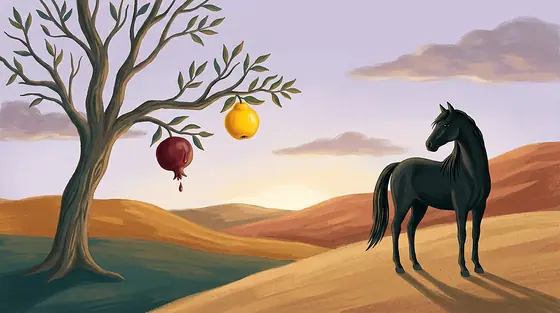
“My Scarlet-Clad Sultana, do not trouble yourself at all, do not be discouraged. Am I the son of the padishah of the peris,18 and cannot find a remedy for so much as this? In the very middle of the private garden of our palace there is a tree, the Weeping Pomegranate and the Laughing Quince. On one side the pomegranates weep and sway, on the other the quinces laugh and grin; there is not its like in the world. Whoever goes up to this tree, the moment he stretches out his hand the pomegranates begin to sob and the quinces to laugh aloud. No one can come near them, no one can lay a hand on them. Tomorrow I shall arm every soldier my father has from head to foot and we shall keep watch under the tree night and day without blinking. When that young man comes we shall surely tear him to pieces. Tomorrow morning, before your father, you will ask that tree of this young man.”
At that the Scarlet-Clad Sultana rejoiced, thinking that this presumptuous kitchen boy had come to his end. And while they talked and conferred like this, devising measures, turning their wheels and laying their schemes, the day began to break and the sky to lighten. And the Dove-Shaped Youth said:
“Oh, I am late; let me slip away at once before trouble comes upon my head.”
And with that he dipped once into the golden basin and shook himself twice, and when the water had run off him he took on a dove’s shape again, and flew out of the window with a whirr.
After him the Scarlet-Clad Sultana too went straight out of her room before the padishah, and began to speak:
“My padishah, in such and such a place, in the very middle of the private garden of the padishah of the peris, there is a tree, the Weeping Pomegranate and the Laughing Quince. If this young man passes this obstacle too and uproots and brings that tree, then I shall say no more, and will have him; otherwise the thing cannot be.”
So she said, and withdrew, and went to her room. And the padishah, having no remedy, turned to this young man:
“Look, my brave one, the third time is God’s own, my child. I explained to you beforehand how matters stood with this girl. Now she has set yet another obstacle. In such and such a place, in the very middle of the private garden of the palace of the padishah of the peris, there is a Weeping Pomegranate and Laughing Quince tree. If you can take and bring that, then I shall certainly give you this girl, and we shall cut this business short and finish it.”
At that the prince said:
“My padishah, everything she asked for I have found and fetched and taken and brought up in time. With God’s leave I shall surely take and bring this tree as well.”
So he said, and saluting from the ground he left the presence and went out of the palace. After going some distance he came to a lonely corner and took from his breast the hairs the dark horse had given him; and when he struck them one against another, in the twinkling of an eye the horse broke out of a cloud of smoke and came snorting up, and called to the prince:
“What is your command, my prince?”
And at this he said:
“Oh my dark one, my soul’s companion — first my God, and then there is only you. In such and such a place there is a palace of the padishah of the peris, and in the middle of its private garden a Weeping Pomegranate and Laughing Quince tree. Now the Scarlet-Clad Sultana wants me to uproot and bring this tree. They say no one can go near this tree or lay a hand on it. Whatever may be done will be done by you — help, my dark one!”
At that the dark horse hung back a little this time:
“Ah my prince, this business is somewhat hard; but let my life be sacrificed on your road. Spring upon my back, hold tight by my reins, brace your legs well, lie down along my neck; let us go once and see how it turns out.”
And at that the girl kissed both the horse’s eyes and sprang at once upon his back; and they broke from the place and went like winds over the plains and like rushing floods down the valleys, and at last came to a country.
As they were going along the road they saw three children. Before them lay a sheepskin, a cap, a whip, and an arrow. These things had come to them as an inheritance from their father, and they could not divide them in any way, and were quarrelling over them.19 Seeing them so, the dark horse found speech:
“Oh my prince, these things are very necessary to you. These children do not know their worth. Talk them round and get them out of their hands.”
At that the prince got down from the horse at once and came to the children.
“Children, why are you quarrelling like this?”
And at that they told him that these things had come to them as an inheritance from their father, and that they could not divide them in any way. The prince took the arrow:
“Look, children, I shall shoot this arrow; whichever of you goes and catches it first and brings it back, the whole of this inheritance shall be his.”
And when he said this the children agreed. The prince took the bow slung crosswise on his shoulder, wedged one end between his two legs, pressed down on the other end with his left hand and slipped the loop of the string over it, and strung the bow in one movement. He put the bone thumb-ring on his finger and settled the arrow in its bed.20 Stretching his left arm out as far as it would go, he drew the string to his chin, said “O God!” and let fly. And while these children watched the arrow’s path and followed where it fell and went dashing after it — the prince gathered up the sheepskin, the cap and the whip that were left there, put three purses of gold in their place, sprang upon his dark horse, mounted the blowing winds and trod the dusty roads, and they flew away. The children went and came back out of breath, and seeing three purses of gold in place of the things, took one purse each with joy and went off playing.
After going a while at a full gallop they came at last before the palace of the padishah of the peris, and halted there. The dark horse stopped:
“Come, my prince, to work. You put the cap on your head, you mount the sheepskin, and you strike with the whip. You will rise into the air, come straight down into the private garden of the palace beside that tree, and at once take hold and pull it out by the roots and come away without stopping.”
At that the prince at once put on the cap, mounted the sheepskin, and the moment he struck with the whip rose into the air and went into the palace. As the prince went about the rooms and apartments, in one of these rooms he saw the Scarlet-Clad Sultana and the Dove-Shaped Youth sitting and talking. The prince came straight over and sat down beside them. Since the magic cap was on his head, the prince could see them, but they could not see the prince. Just then food was brought in, and as the two of them sat down and began to eat, the prince too sat down at one corner of the table and set to. They looked and saw that on the far side of the dish, although no one had touched it, the food was slowly growing less. The Dove-Shaped Youth said:
“My sultana, this place in front of me is mine, that place is yours — but whose place is that opposite? The food there is going down as if it were being eaten.”
And when he said this the girl too was astonished, and they could make no sense of it. When they had finished eating they went and sat in the window on the divan. The Scarlet-Clad Sultana had given the son of the padishah of the peris an embroidered kerchief as a gift. The prince took this kerchief that lay on the divan and hid it in his breast. Presently they turned and looked and saw that the kerchief that had been on the divan was gone. Saying it must be here, it must be there, they ransacked the room from end to end; the kerchief had vanished without trace. By then night had fallen. The prince, judging that the time had come, struck the sheepskin once with the whip, rose into the air, came straight down upon the Weeping Pomegranate and Laughing Quince in the middle of the private garden, took hold of the young tree and with all his strength tore it up by the roots. On its branches the pomegranates sobbed and the quinces laughed aloud. With the sapling in one hand and the whip in the other, the prince struck the sheepskin and flew away. The soldiers who were there saw only afterwards that the sapling had been pulled up by the roots and carried off into the air, and could not tell what had happened. They drew their weapons and fell upon one another and raised an uproar. Crying “Quick, don’t stand there, they have seized the tree, they are carrying it off!” they could not tell in the dark whom they were striking, and in the confusion they cut one another down, each taking the other for the enemy. The Scarlet-Clad Sultana and the Dove-Shaped Youth were watching all this from the palace window. When they saw the tree rise into the air and go, they both said, “Alas, the thing is done!” and only then understood what had happened. The son of the padishah of the peris could not stomach this for his honour and his pride:
“My sultana, the one who was eating opposite us, and who took the keepsake kerchief you gave me, is this over-clever young man. He has passed every obstacle. He is a brave one, quick of hand and swift of counsel. There — he has taken it and gone. I am beaten, my strength is broken. You have fallen away from me; be whose beloved you will from now on.”
So he cried out, and went into the golden basin, shook himself twice, poured the water off his back, took on the dove’s shape and flew out of the window with a whirr, and was gone.
The Scarlet-Clad Sultana went out from there weeping and weeping, and came running to her father’s palace. As the sun rose and the day began to grow light, she came before her father.
Let us come to the prince. With the sapling in his hand, striking the sheepskin with his whip, he came flying to the dark horse. Springing upon his back they broke from the place and passed like winds over the plains and like rushing floods down the valleys, and came before the padishah’s palace. The prince went straight into the padishah’s presence and set down the sapling the Scarlet-Clad Sultana had asked for:
“Here, my padishah, I have taken and brought the sapling your sultana daughter asked for.”
At that the padishah was lost in astonishment:
“Well done, my son — light of foot beyond measure, quick of hand, swift of mind; in a word, you have turned out a most capable young man. To give my daughter to, I could find no one more fitting than you, nor better. Let there be an end now to coyness and to pleading. Girl, set aside your obstacles and your games and your schemes — let the wedding feast be made ready, let the crier cry, send out the messengers, let them carry the word, let the couriers take to the roads and deliver the decree. Let slave and gentleman, neighbour and acquaintance, all be gathered.”
And when he had so decreed, the Scarlet-Clad Sultana had neither sound nor voice; her mouth was locked. She had given up all hope of obstacle, scheme or game, and resigned herself to what had come upon her; the branches she had trusted had withered. She stood with her head bowed before her. She had come to understand this prince’s superiority very well; and while on the one hand her wits were scattered by the speed of all that had happened, on the other she looked sidelong at this young man, and her heart flowed towards him. As the Scarlet-Clad Sultana came little by little out of the enchantment and turned towards the truth, she began to understand very well from what a calamity she had escaped and to what happiness she had come.
From there they made a wedding feast of forty days and forty nights. When everything was finished and the gathering broke up and began to scatter to its own places, the prince took the Scarlet-Clad Sultana and mounted his dark black horse and, passing like floods down the valleys and winds over the plains, returned to his mother and his own country, and was reunited with them. He embraced his mother at once and kissed his father’s hand, presented his bride and told them briefly all that had happened. As his father and mother listened they were now afraid, now joyful, and were left in wonder. And in his father’s country too a wedding feast of forty days and forty nights was held; envoys, couriers and messengers were sent to seven climes and four corners, and guests came and gathered. Such presents came as could not be fitted anywhere. They laughed and danced, they played and sang. They ate the pilafs heaped like mountains and the meats piled like hills and put them away, and drained the ayran and the sherbets that ran like rivers. The hungry were fed and those with nothing on their backs were clothed. They made no distinction between townsman and stranger, and scattered bright gold coins to everyone who came and went.
They attained their heart’s desire; may we attain ours.21
Translator’s Notes
1. The tale opens with a rhyming formula: Bir varmış, bir yokmuş, Tanrının kulu çokmuş. Çok demesi, yok demesi günahmış — “there was one, there was none, God’s servants were many; to say many, to say none, was a sin.” The rhyme carries it, not the sense; it is a sound-shape that tells the listener the story has left ordinary time. The sense has been kept and the rhyme lost. ↩
2. Sünnet is circumcision. In Ottoman and Turkish custom a boy’s circumcision at around ten to fourteen is a public rite with a feast — the sünnet düğünü, literally “circumcision wedding” — lasting days, with guests, processions and gifts, by which a boy is shown to the community as a boy. This is why the whole plot turns on it: it is the one event the mother’s secret cannot survive, because it is both medical and public. The padishah’s phrase mürvet günü — rendered here as “the day of his son’s coming of age” — names the same occasion as a father’s day of fulfilment in his son. ↩
3. Turkish has no grammatical gender: the single pronoun o serves for “he,” “she” and “it,” and the verb endings mark no gender either. The original can therefore let the child be a child, and the reader can hold both readings at once without the narrator ever committing to one. English has no such room. This translation uses “she” while the heroine is a girl living as a boy, and switches to “he” at the point where the giants’ curse takes effect — the same point at which the Turkish text itself switches from kız (“girl”) to şehzâde (“prince”) as its noun for the character. The switch in English is sharper than in the original, and that sharpness is the translator’s, not the tale’s. ↩
4. El pençe divan durmak, “to stand in divan with hands clasped”: the formal posture of a subject before a ruler, hands folded one over the other below the waist, eyes lowered. It recurs throughout the tale as the mark of a correctly behaved petitioner. ↩
5. Yağız describes a horse’s colour — dark brown-black, with no white marking anywhere. The heroine calls him karga karam, “my crow-black,” and kara yağızım, “my dark one”; the colour is also his name. “Dark one” and “crow-black” have been used to keep both. ↩
6. The Turkish text as printed in the source is corrupt at this point (Aman kara at şahzar ■deyi aldı kaçırdı), evidently a scanning error for şehzâdeyi — “the black horse has taken the prince and carried him off.” The reading is given here as reconstructed; a handful of other obvious scanning slips in the source (meret for medet, beim for benim, Tebdil Sezen for Tebdil Gezen) have been silently read as intended. ↩
7. Keşkek is a dish of wheat and meat pounded together in a great mortar until it draws out into threads; the pounding is communal, rhythmic and loud, and at feasts it is done to a call-and-response chant — here Hay Hak, hay hak, “O Truth, O Truth,” one of the names of God used as a work-rhythm. The whole kitchen passage is written as a list of noises and smells rather than of dishes. ↩
8. Hızır (Khidr) is the immortal helper of Turkish and wider Islamic tradition who appears without warning at the moment of greatest need and vanishes again. Hızır gibi yetişmek, “to arrive like Hızır,” is still an everyday phrase for timely rescue. ↩
9. The Turkish is dev — the creature of Turkish and Persian tale, man-shaped, enormous, often sleeping in caves and often, as here, tied to a place by a periodic tribute. It is not the giant of European folklore, though “giant” is the closest single word English has; the text calls this one a dev azmanı, a “monstrous” or “overgrown” dev. ↩
10. The colour code is the whole characterisation. The sisters sit in black — kara giyimli — because the household is in mourning in advance for a father who is expected to die tonight. The one sister in scarlet, al giyimli, is refusing to mourn. Her father reads this as heartlessness (“stone-hearted dealer in coquetry”); the tale, in the end, does not. ↩
11. A kel yamak — “you bald scullion.” Kel, “bald” or “scald-headed,” is an insult, but in Turkish tales it is also the mark of the hero in disguise: Keloğlan, “the bald boy,” is the archetypal ash-lad of the tradition, despised in the kitchen and victorious by the end. The padishah’s insult is, without his knowing it, a piece of praise. ↩
12. The Turkish is Kul töresi dua, hakan töresi keremdir — “the subject’s custom is prayer, the khan’s custom is bounty.” It states the rule being followed: a petitioner must decline twice out of courtesy, and a ruler must ask three times, before a real request may be spoken. The heroine’s two refusals are not modesty but protocol. ↩
13. İstihare is the practice of praying before sleep for guidance and taking the resulting dream as an answer. It is a real religious practice, and in tales it is also — as here — a perfectly respectable way of buying one more night. ↩
14. Yektir Allah, yek — “God is one, one.” The night watchmen’s call, passed from gate to gate and tower to tower to show that each man is awake at his post. ↩
15. The sign is inverted on purpose: the giants sleep with their eyes open and wake with them shut. It is a standing motif of the Turkish dev, and the horse has to explain it because it is counter-intuitive to the hero as well as to the listener. ↩
16. Şimşek taşı, “lightning stone.” Thunderstones — stones believed to fall with lightning and to hold its power — appear across Anatolian belief as charms. The tale does not say what this one does; it is wanted because it cannot be got. ↩
17. The curse is the hinge of the tale, and it is a curse only in the giants’ mouths. Er isen kız, kız isen er yiğit olasın — “if you are a man may you become a girl, if you are a girl may you become a brave young man.” The giants, enraged and not knowing whom they are cursing, hand the heroine the one thing she has needed since the first page. She says so herself: Tanrıdan dilediğim ancak bu idi — “this was the one thing I asked of God.” The rhymed, balanced shape of the curse in Turkish (er isen kız, kız isen er) cannot be reproduced in English without losing the sense, and has been let go. ↩
18. Peri are the spirit-folk of Turkish and Persian tradition: beautiful, winged, organised into their own kingdoms with their own padishahs and armies, and able to take bird form. They are not the fairies of English folklore and the word has been left untranslated. ↩
19. Three brothers quarrelling over a dead father’s magic objects, settled by a hero who shoots an arrow and makes off with the inheritance while they chase it, is an international tale-type motif (ATU 518, “Men Fight over Magic Objects”). Here the hero pays for them — three purses of gold left in their place — which is not usual, and is the tale’s own comment on its hero. ↩
20. The bow-stringing is described step by step because it is a display of competence: bracing the bow between the legs, slipping the loop of the string over the nock, and fitting the zehgir, the archer’s thumb-ring of bone or horn used in the Ottoman draw, in which the string is pulled with the thumb rather than the fingers. The heroine, raised as a boy, does it in one movement. ↩
21. The closing formula Onlar ermiş muradına, darısı bizim başımıza — “they attained their heart’s desire; may its grain fall on our heads too,” that is, may our turn come next. It hands the listener back to ordinary life. ↩