The Wolf — A Kastamonu Folk Tale
ℹ️ This is an English translation of a Turkish oral folk tale. The regional dialect of the source text could not be fully preserved in translation. Read the Turkish original here.
“The Wolf” is a short animal tale of the Kastamonu region, recorded from the narrator Sait Tekin in Sagıp Atlı’s 2011 master’s thesis on the folk tales of Kastamonu. A hungry wolf meets three animals on the road, and each one sends him away empty.
ℹ️ This is an English translation of a Turkish oral folk tale. Read the Turkish original here: KURT.
The Wolf (A Kastamonu Folk Tale)
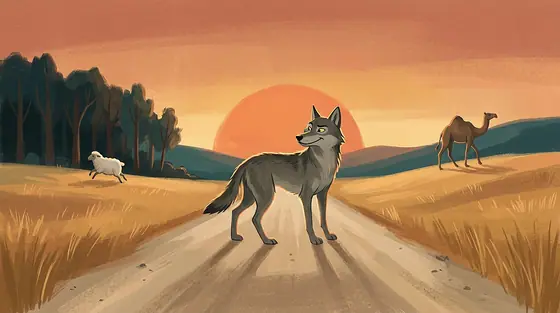
Once upon a time a certain wolf was going on up the road.1 And just then, when the wolf’s belly grew hungry, the wolf says: “I shall eat the first animal that comes before me on the road.”
As he goes along the road a sheep comes his way. The wolf takes hold of the sheep: “I am going to eat you.”
“You are going to eat me, but first you lie down face-down in the middle of the road.2 Let me jump over you a time or two, up and down, and then you eat me,” it says. The wolf lies down in the road, and then, after the sheep has jumped up and down a time or two, off it runs into the forest. The wolf gets up and looks, and there is no sheep.
The wolf goes on walking up the road again. Just then a camel comes his way. The wolf takes hold of the camel: “I am going to eat you.”
“You are going to eat me, but first let me lie down on the ground and you climb up on me. Let me get up, and you give the call to prayer;3 after that I shall lie down again, and then you eat me,” it says. The camel lies down on the ground and the wolf climbs up on it. When the camel gets up on its feet and gives itself a shake, the wolf falls head over heels to the ground. After that the wolf’s wits go out of his head, and just at that moment the camel runs off too.
Then the wolf goes on with his walk. Just then a mule comes before the wolf. The wolf takes hold of the mule: “Friend, I am going to eat you.”
“Friend, you are going to eat me, but eat me after you have read the number on the shoe under my foot,” it says.4
Just as the wolf steps up to read the number on the shoe, the mule kicks him and knocks him flat. When the wolf faints there, the mule runs off at once. Then the wolf comes to his senses. He gets to his feet and looks, and there is no mule. He thinks over the things he has done, one by one. When the animals he let slip out of his hands come into his mind, feeling himself to be a stupid beast, he says to himself:
“On the road you found a sheep — eat its meat your fill, your fill.”5
Were you going to make the sheep dance and become chief of the band, you great head?6 A camel came your way; were you going to climb up on the camel and give the call to prayer and become chief muezzin, you great head?
“A mule came your way — eat its meat, crunch and crack.”
Were you going to read the number on its shoe and become chief farrier, you great head?7
Translator’s Notes
1. Yola yukarı gidiyormuş, “he was going on up the road,” is regional phrasing. The wolf sets off again twice after this, once with the same phrase (yine yola yukarı yürümeye devam eder) and once without it (sonra kurt yürüyüşüne devam eder); the tale is built out of three turns of nearly the same sentence. Note also that the narration slips between the reported -mış past of tale-telling and the plain present tense (der, “says”; rast gelir, “comes his way”) from the second sentence onwards. That is in the original — a storyteller warming up and dropping into the present to carry the action — and it has been kept rather than smoothed into one tense. ↩
2. The Turkish is yüzün guylu, a regional pronunciation of yüzün koyulu — face-down, flat on your face. The sheep’s trick depends on it: a wolf lying on his face cannot see the sheep go. ↩
3. Ezan okumak is to chant the Muslim call to prayer, which is given from a height — a minaret, or in this case the top of a standing camel. The camel’s proposal is absurd on purpose, and the wolf agrees to it without blinking. ↩
4. Horseshoes and mule shoes were stamped with a size number by the farrier. To read it the wolf must put his face directly behind the animal’s hoof, which is the whole of the joke. The source says only şu ayağımın altındaki nal, “the shoe under this foot of mine,” and does not say which foot. ↩
5. The wolf’s self-reproach is in rhymed couplets — Yolda buldun bir koyun / Ye etini doyum doyum and Önüne rast geldi bir katır / Ye etini çatır çatır — in which the second line ends in a reduplicated sound-word: doyum doyum, “fill upon fill,” and çatır çatır, the crunching noise of eating. The rhyme and the noise carry the lines; neither survives in English, and the sense has been kept. The camel gets no couplet of its own and is scolded in prose instead; that unevenness is in the original. ↩
6. Mehter başı — chief of the mehter, the Ottoman military band, whose players marched and swayed in step to their own drums. The wolf is mocking himself for having stood by while the sheep hopped over him: as though he had been auditioning as a bandmaster rather than eating his dinner. The three jeers run through three professions with a chief at the head of each — bandmaster, muezzin, farrier — and each one names exactly the trick that was played on him. ↩
7. Be hey kafa, repeated after each jeer, is an exasperated vocative, roughly “you head!” — the wolf addressing his own stupidity. The tale ends on it, with no closing formula at all. ↩
On the tale as a whole. Offered by the translator and not taken from the source: this is a Turkish form of the widespread animal tale in which a hungry predator is talked out of its prey by one victim after another, each inventing a delay — catalogued in the international index among the tales of the duped wolf (the ATU 122 group, “The Wolf Loses His Prey”). The thesis from which the text comes is an academic study and will carry its own classification; this archive has not seen that page, so no type has been entered in the record.
On the register. The Turkish is a field transcription of someone actually speaking: it keeps regional pronunciations (guylu), regional phrasing (yola yukarı), the tense-slipping described in note 1, and the storyteller’s habit of finishing with a burst of rhyme and scolding. The record marks the tale as having no dialect note, though these features are present; the translation keeps the register plain and spoken rather than inventing an English dialect for it.